
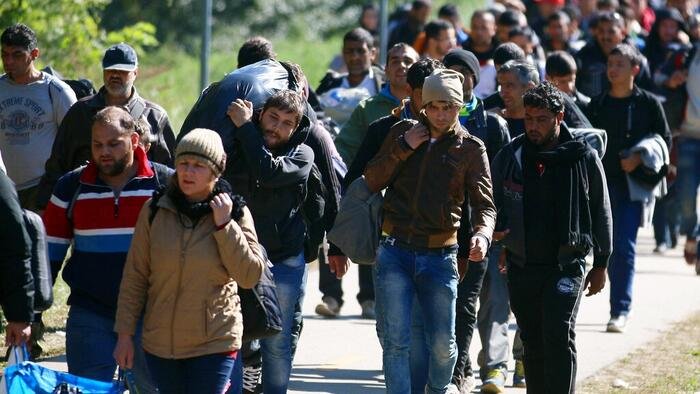
Dutch migration researcher and social scientist Ruud Koopmans has raised concerns about the rapid naturalization of migrants, warning of a potential “demographic time bomb” that could result in 7 million Syrians living in Germany within the next 50 years. Koopmans attributes this significant growth to family reunification policies, which allow relatives of newly naturalized migrants to join them in Germany. He emphasizes that the current approach to naturalization could have far-reaching consequences for the country.
Koopmans questions the expedited process of granting German citizenship to refugees, particularly under the previous far-left government led by Chancellor Olaf Scholz.
“There needs to be a consideration of whether refugees should be granted German citizenship so quickly. By becoming German nationals, there is no restriction on family migration, making it challenging to manage the influx of migrants,” he stated in an interview with Cicero.
“This rapid naturalization process could potentially lead to a demographic crisis in the long run,” he added.
He highlights that the recent removal of the option for “turbo naturalization” after three years by the current government, although this option was rarely utilized, with only a few individuals benefitting from it in certain German states.
Standard naturalization, which requires five years of residency, is still a viable pathway for migrants seeking German citizenship.
“I see a challenge with the naturalization process. The restriction on family reunification only applies to those with subsidiary protection until they acquire German citizenship. While the recent reform eliminated accelerated naturalization after three years, standard naturalization after five years—applies even to refugees—remains a possibility,” he explained.
Foreigners in Germany can attain citizenship after five years by demonstrating legal residency, financial independence, a clean criminal record, and proficiency in German. However, concerns have been raised about instances of fraudulent behavior during German language exams.
Many of the newly naturalized citizens are men who are likely to seek family reunification in Germany.
“It’s crucial to consider the implications of this trend for the future. The majority of these individuals are men who will likely seek spouses from their home countries. In these societies, marriage often involves extended families and serves as an economic exchange, with entry into Europe being a significant factor,” Koopmans noted.
He pointed to the exponential growth of previous immigrant populations, such as the Turkish community, who have utilized family reunification policies to increase their numbers significantly. Turks in Germany now exceed 6 million and face integration challenges, exemplified by recent gang conflicts in Berlin.
“Looking back at history, we can observe how the population of guest workers from Turkey and other countries has multiplied through family reunification and natural growth. If we project a similar trajectory for Syrians—and other nationalities like Afghans, Iraqis, and Somalis—we could potentially see 7 million Syrians or individuals of Syrian descent in Germany in 50 years. This scenario is not implausible given past trends,” Koopmans emphasized.
🇩🇪🔴German police say members of an extended Syrian clan family are said to have committed at least 160 crimes in Stuttgart.
They have cost Germany nearly €500,000 in prison detention fees alone, and that is just for 5 of the highly criminal family.
Now, Germany was so… pic.twitter.com/At9ZKozb5U
— Remix News & Views (@RMXnews) December 23, 2025
Koopmans suggests that a minimum of 10 years of residency should be required before individuals are granted long-term stay in Germany, as five years may be too soon to make such decisions.
“If individuals have resided in Germany for a decade and have integrated into society, it may be appropriate to offer them a pathway to permanent residence. However, doing so after just five years seems premature,” Koopmans remarked.
He distinguishes between different immigrant groups, noting that challenges related to employment integration and crime rates are more prevalent among specific communities. He attributes these issues to the lack of effective migration controls, emphasizing that not all immigrant groups exhibit high crime rates. For instance, migrants from other EU countries tend to have better employment outcomes and lower crime rates.
Nevertheless, given the ongoing demographic shifts, the large number of recent naturalizations poses a significant demographic challenge for Germany in the years ahead, reflecting the substantial influx of migrants over the past few decades.
Recent polls indicate that a majority of Germans now support an immigration moratorium, signaling a shift in public attitudes towards mass immigration over the past decade. Additionally, Syrians have been disproportionately involved in criminal activities in Germany, further fueling concerns about the implications of continued migration.
Loading recommendations…