
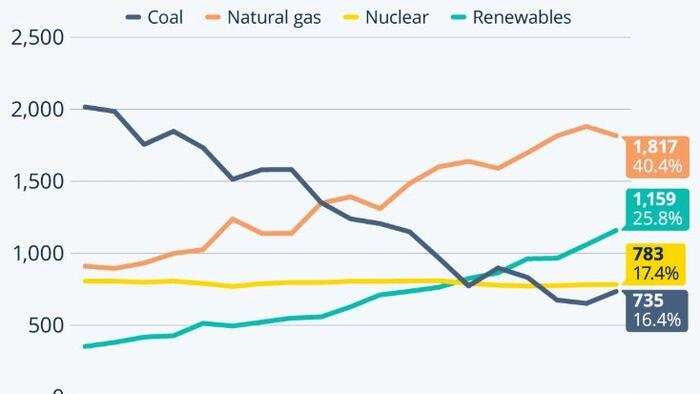
By 2025, renewable energy sources in the U.S. have surpassed a 25 percent share in electricity generation, marking a significant increase from just 8.6 percent in 2007.
Coal, once the predominant electricity source in America, has seen a sharp decline from 49 percent to 16.4 percent last year, as illustrated in the infographic by Statista’s Katharina Buchholz below:
For more infographics, visit Statista
Despite uncertainties surrounding the Trump administration’s policies on renewable energy and greenhouse gases, experts anticipate further growth in the sector due to efficiency improvements and cost reductions. While the pace may slow down, the trajectory remains upward, even in the face of government funding cuts and the relaxation of emission limits.
In 2022, renewable sources exceeded coal in electricity generation for the first time in the U.S., producing over 900 terawatt-hours compared to just over 800 from coal.
The global shift towards renewables over coal was solidified in the latter half of 2025, indicating a broader trend towards sustainability and cleaner energy sources.
Historically, coal dominated electricity generation in the U.S. until 2007, when stricter regulations on fossil fuels prompted a decline. Natural gas emerged as a viable alternative, emitting less CO2, but the ultimate goal of achieving net-zero emissions requires a continued focus on carbon-neutral sources like wind and solar, now the second-largest contributors to the U.S. power grid.
While progress is evident in electricity generation, the broader energy landscape still heavily relies on non-renewable sources, with renewables accounting for just 9 percent of total energy consumption in the U.S. as of 2023.
Loading recommendations…