SOME CARD INFO MAY BE OUTDATED
This page includes information about these cards, currently unavailable on BW. The information has been collected by BW and has not been provided or reviewed by the card issuer.
The rising popularity of premium credit cards has coincided with a torrent of statement credit benefits offering cardholders cash back for select purchases. Some of these statement credits can be worth hundreds of dollars, and card issuers aren’t shy about flaunting that potential value in marketing material.
However, while card issuers don’t explicitly misrepresent the value of these statement credit benefits, they do project optimal scenarios in which cardholders capture every dollar of credit available. In practice, most cardholders will capture only a fraction of that value.
Rather than accept these benefits at face value, I advocate that cardholders assess for themselves the value of credits based on their own needs, interests and circumstances.
Why I don’t take statement credit benefits at face value
Given the choice between a statement credit and its cash equivalent, I would always choose cash. Statement credits are less flexible and add complications you don’t get with cash. I also discount statement credits for other, more specific reasons.
I don’t always need or want the credits I’m offered
Some statement credit benefits cover purchases I already plan to make, such as the $300 annual travel credit on my Chase Sapphire Reserve® card. That benefit reimburses me for a wide variety of travel expenses, including airfare, hotels and rental cars. Since I typically book with that card for its travel protections, the credit is almost as good as cash to me.
I can’t say the same for all such benefits, many of which cover purchases I would be unlikely to make otherwise. I’m happy to try products that are mostly or fully covered, such as the complimentary Walmart+ membership I get from my Amex Platinum card, but I get minimal value from it. Other credits are completely worthless to me, such as the $10 monthly Peloton credit on the Chase Sapphire Reserve card (through 12/31/2027).
Redeeming credits isn’t always easy
The easier a credit is to redeem, the more it’s worth to me. Unfortunately, many statement credit benefits limit how, where and when they can be used, which makes redeeming their full value more difficult.
Some credits are limited by applying only to a narrow selection of purchases, such as the American Express® Gold Card’s up to $120 dining credit, which is divided into a monthly credit of up to $10 at participating partners (enrollment required; terms apply). The list of eligible partners is restricted to Grubhub, The Cheesecake Factory, Goldbelly, Wine.com and Five Guys, and since I don’t do business with any of them regularly, the credit is far less valuable to me than one that could be redeemed at any dining establishment.
Other credits are limited by terms that prevent me from redeeming them how I want. For example, the Chase Sapphire Reserve card comes with an annual credit of up to $500 toward stays booked with Chase’s luxury hotel and resort collection, The Edit.
However, that benefit is split into two semiannual $250 credits, which apply only to stays of two nights or longer. That means I can’t redeem the full amount at once nor put it toward single-night stays. Those constraints make the benefit much less valuable to me than one $500 credit that I could redeem against any hotel stay.
Finally, redeeming statement credit benefits takes effort. Some credits require enrollment prior to use, and I have to keep track of unused portions so they don’t expire. Occasionally, I run into credits that don’t work as they’re supposed to, which means having to contact my card issuer to get credited manually. These are minor concerns, but they widen the gap in value between statement credits and cash.
Using credits may mean passing up a better deal
I discount the value of statement credits when I could buy the same credit outright for less than the face value. For example, I get up to $200 of credit toward U.S. Uber Eats and rides each year from my American Express Platinum Card® card. (After adding your American Express Platinum Card® to your Uber account, you’ll automatically get $15 in Uber Cash each month, plus a $20 bonus in December, for a total of up to $200 per year.) Enrollment required; terms apply.
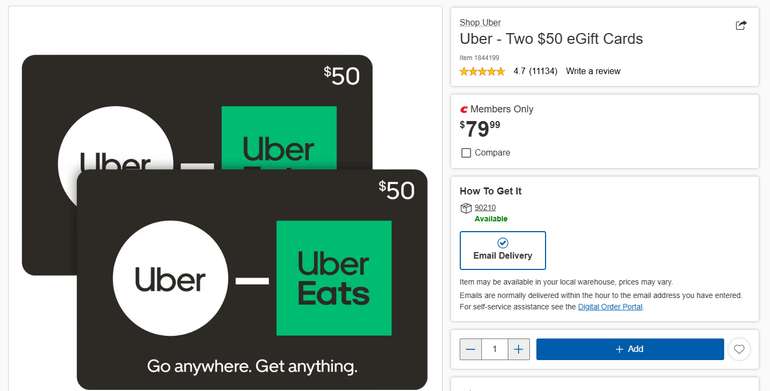
However, Costco routinely sells Uber gift cards for around 20% off, so I could buy $200 of Uber credit for a few cents under $160.
Likewise, I utilize the $10 monthly credit for wireless phone service with The Business Platinum Card® from American Express, even though it only earns me 1 point per dollar compared to the 5 points per dollar I could earn with my Chase Ink Business Cash card. After factoring in additional perks like airport lounge access, the card stands out as a definite keeper for me. following sentence: “The cat jumped onto the table and knocked over a vase.”
The vase was knocked over by the cat as it jumped onto the table.