
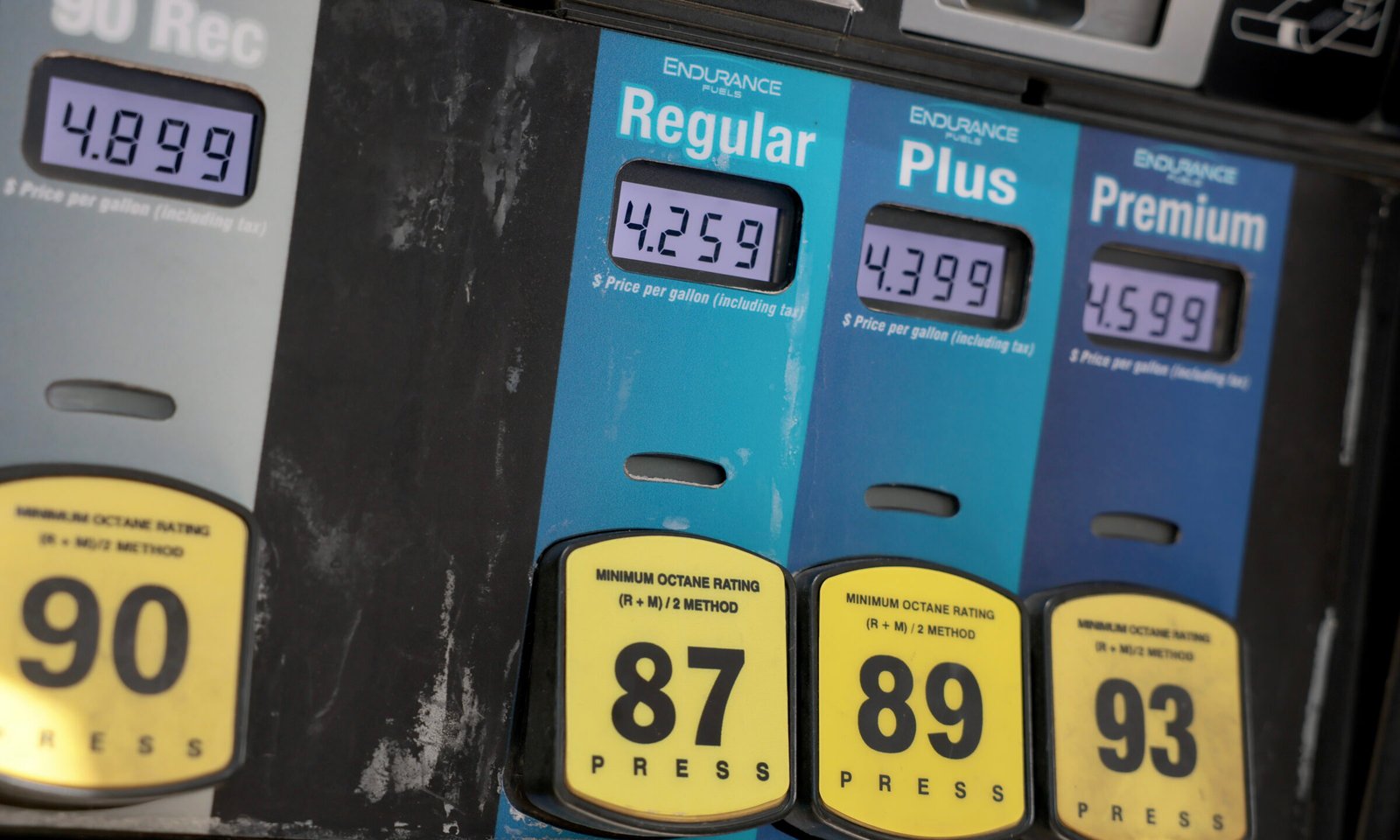
The war in Iran may be on pause, but its effects on prices are still in motion and will continue to ripple through the economy after more than a month of disruption to the global oil supply.
After the U.S. and Israel began their attacks on Feb. 28, Iran responded by closing the Strait of Hormuz, a critical chokepoint for the world’s oil supply and other key materials. Brent crude — the global oil benchmark — traded at around $80 per barrel before the attacks but spiked to well above $100 per barrel as the war wore on.
The White House has been inconsistent in its messaging about the war’s aims and how long it might last, and has been trading rhetoric with Iran about how to end the conflict. Things came to a head this week as President Donald Trump set a Tuesday deadline for a ceasefire agreement — threatening to attack Iranian infrastructure and wipe out an entire “civilization” if no deal emerged.
Meet MoneyNerd, your weekly news decoder
So much news. So little time. BW’s new weekly newsletter makes sense of the headlines that affect your wallet.
SUBSCRIBE FOR FREE
On Tuesday night, less than two hours before Trump’s deadline, the two nations brokered a two-week ceasefire to allow for continued negotiations on a longer-term deal. Iran agreed to reopen the Strait of Hormuz during the pause, though the ceasefire is off to a tenuous start: On Wednesday, Iran accused the U.S. of violating the terms of the deal, as Israel continued attacks on Lebanon.
Following Tuesday night’s ceasefire announcement, oil prices fell quickly and have settled near $95 per barrel, and U.S. stocks rallied.
War adds to already-rising inflation
The war’s economic impact is compounded by the ripple effect of tariffs already in place before the war began. On March 2, just a few days after the initial attacks, the Yale Budget Lab released an updated assessment of tariff impacts on consumer prices, finding that costs of imported consumer goods passed onto consumers runs anywhere from roughly 40%-76% for “core goods” — like electronics and apparel — and 47%-106% for “durable goods” — like motor vehicles and household appliances.
Wells Fargo analysts cautioned in a March 23 report against over-extrapolating early data. “Early last April, the president’s proposed tariffs seemed to some a guarantee of an economic recession. That didn’t happen,” the note read. Analysts said that the crude oil price surge would likely produce global consumer price inflation, but noted that political and economic constraints will likely shorten the war’s duration. “While some risk remains for extensive structural damage to Persian Gulf energy infrastructure, we believe that both sides prefer not to destroy what generates almost all the region’s income,” analysts said in the note.
Meanwhile, the Organisation for Economic Co-operation and Development (OECD) says that the war in Iran will test the resilience of the global economy. A March 26 report by OECD projects that inflation in the U.S. will average 4.2% in 2026, reflecting higher energy prices due to oil market disruptions. A prolonged conflict in the Middle East could result in an even steeper price shock, it says.
Is the U.S. headed for a recession?
If the ceasefire fails to hold and hostilities continue into June, oil has a 40% chance of hitting $200 per barrel, according to Macquarie Group, an investment banking firm. A spike of that size could push consumer prices even higher, roil markets and push an already fragile economy over the edge.
“My sense is if we hit $150 to $200 a barrel for a month or two, that’s very likely to tip the economy into recession,” says Daniil Manaenkov, a U.S. forecasting specialist and economist at the University of Michigan.
The International Monetary Fund (IMF) has raised concerns about the potential economic impact of a prolonged conflict in the Middle East. The IMF analysts believe that the duration of the war, its spread across the region, and the damage to infrastructure and supply chains will determine the extent of the economic fallout in the coming days, weeks, and months.
One of the immediate effects of the conflict is the rise in energy prices. It typically takes six to 12 months for these price increases to filter down to consumers in the form of higher costs for various goods and services. Diesel prices, in particular, play a significant role in driving up overall costs as they affect transportation and shipping costs. The increase in diesel prices has already reached approximately 50% since the war began.
Several sectors are likely to experience increased costs as a result of the conflict in Iran. These include transportation of goods that rely on diesel, air travel, food production, plastics and packaging, synthetic clothing, technology and electronics, aluminum, and automobiles. The disruptions in the supply chains for these industries could lead to shortages and higher prices for consumers.
Even after the war ends, the flow of oil through the Strait of Hormuz may not return to normal immediately, keeping global fuel costs elevated. Iran’s ability to regulate oil flow gives them leverage to maintain economic pressure even after the conflict ends. The recent attack on Saudi Arabia’s oil pipeline highlights the ongoing unrest in the region and the potential for further disruptions to global energy supplies.
Article Title
Lorem ipsum dolor sit amet, consectetur adipiscing elit. Nulla nec leo ut dolor ultricies lacinia. Sed sit amet quam nec urna vehicula vestibulum. Integer at sapien leo.

Donec nec felis eu neque tempor efficitur. Vivamus eleifend mauris eget justo commodo, eget pellentesque nulla malesuada. Fusce luctus sapien id risus feugiat, vitae suscipit metus iaculis.
Sed vestibulum dapibus ligula, nec placerat libero. Cras non elit nec elit iaculis ultricies. Curabitur auctor bibendum libero ac aliquet. Morbi aliquam sapien vel turpis consectetur, non scelerisque neque mollis.