
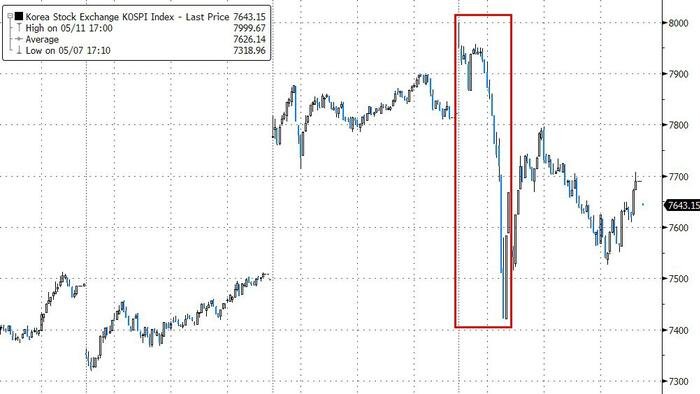
During the night, Korean markets experienced pressure as politicians discussed the possibility of tapping into AI profits.
An article from Bloomberg mentioned that a prominent South Korean policymaker suggested that the country should distribute a ‘dividend’ to citizens using taxes generated from AI profits, with implications for companies like Samsung and SK Hynix.
The statements made in a Facebook post by presidential policy chief Kim Yong-beom caused significant fluctuations in Korean stocks on Tuesday as investors tried to understand the implications of the proposals.
“Profits in the AI era tend to be concentrated,” Kim wrote.
He noted that memory companies, key engineers, and asset holders in Seoul were likely to benefit greatly, while the middle class may only see indirect effects.
The specifics of any potential dividend, and how Kim’s suggestions would be put into action, were not immediately clear.
Nevertheless, investors reacted.
“Following an 80% increase this year, the market was becoming sensitive to any news that could cause investor anxiety,” said Kim Dojoon, chief investment officer at Zian Investment Management.
“Policy chief Kim’s post was easily misinterpreted by the market at such a time.”
The KOSPI benchmark initially dropped by as much as 5.1% (equivalent to over $300 billion in market cap)…
The impact extended to Europe and is affecting Nasdaq futures in pre-market trading…

However, as the repercussions of his statement rippled through the markets, damage control was quickly implemented, with the influential policy advisor clarifying that he intended to utilize “excess tax revenue” from the AI boom instead of introducing a new windfall tax on corporate profits.
An official from the president’s office informed Bloomberg News that Kim’s comments reflected his personal views and were not part of formal discussions.
Nevertheless, this incident is the latest instance of politicians highlighting how the rise of AI could exacerbate the gap between the wealthy and the less fortunate.
In South Korea, this concern has led to public demands for industry leaders to distribute more of the benefits from the global AI infrastructure expansion.
Although Kim’s suggestions are in the early stages, if implemented, they would represent one of the first concerted government efforts to distribute the gains from the AI boom.
As Rich Privorotsky, head of Goldman’s One-Delta desk, pointed out this morning, this concept could have global resonance given the significant concentration of AI earnings and the disproportionate advantages enjoyed by mega-cap winners.
The rapid influx of speculative investments in semiconductors, along with the proliferation of leveraged structures in Korea and the US, raises concerns about the fragility of this rally, but the fundamental thesis of ‘we need more tokens’ remains unchanged.