
For years, SWIFT has been the backbone of global banking, linking over 11,000 financial institutions.
Now, SWIFT is venturing into tokenization, aiming to unite digital assets, tokenized securities, and bank money under one interoperable framework.
If successful, this endeavor could facilitate the migration of trillions of dollars in stocks, bonds, and other tangible assets onto blockchain platforms.
Transitioning from Messaging Leader to Tokenization Facilitator
Established in 1973, SWIFT does not physically transfer money. Instead, it provides a secure messaging platform that banks use to relay payment instructions across borders.
Its main strength has always been its interoperability, allowing banks worldwide to communicate using standardized protocols.
This advantage is increasingly crucial as tokenized assets surface on various blockchains with distinct protocols.
SWIFT’s solution is to link banks, blockchains, and tokenized assets through a common interoperability layer.
SWIFT’s Approach to Tokenization
SWIFT is not constructing its own blockchain network.
Instead, it is expanding its existing messaging infrastructure to connect institutions with multiple blockchain networks.
In 2022, SWIFT initiated collaborations with Chainlink, Citigroup, and BNY to pilot tokenized asset transfers across diverse blockchain networks.
The trials demonstrated that a single SWIFT instruction could trigger transfers across both blockchain and traditional banking systems.
Subsequently, the organization broadened testing to settlement, collateral movement, and corporate actions involving tokenized assets.
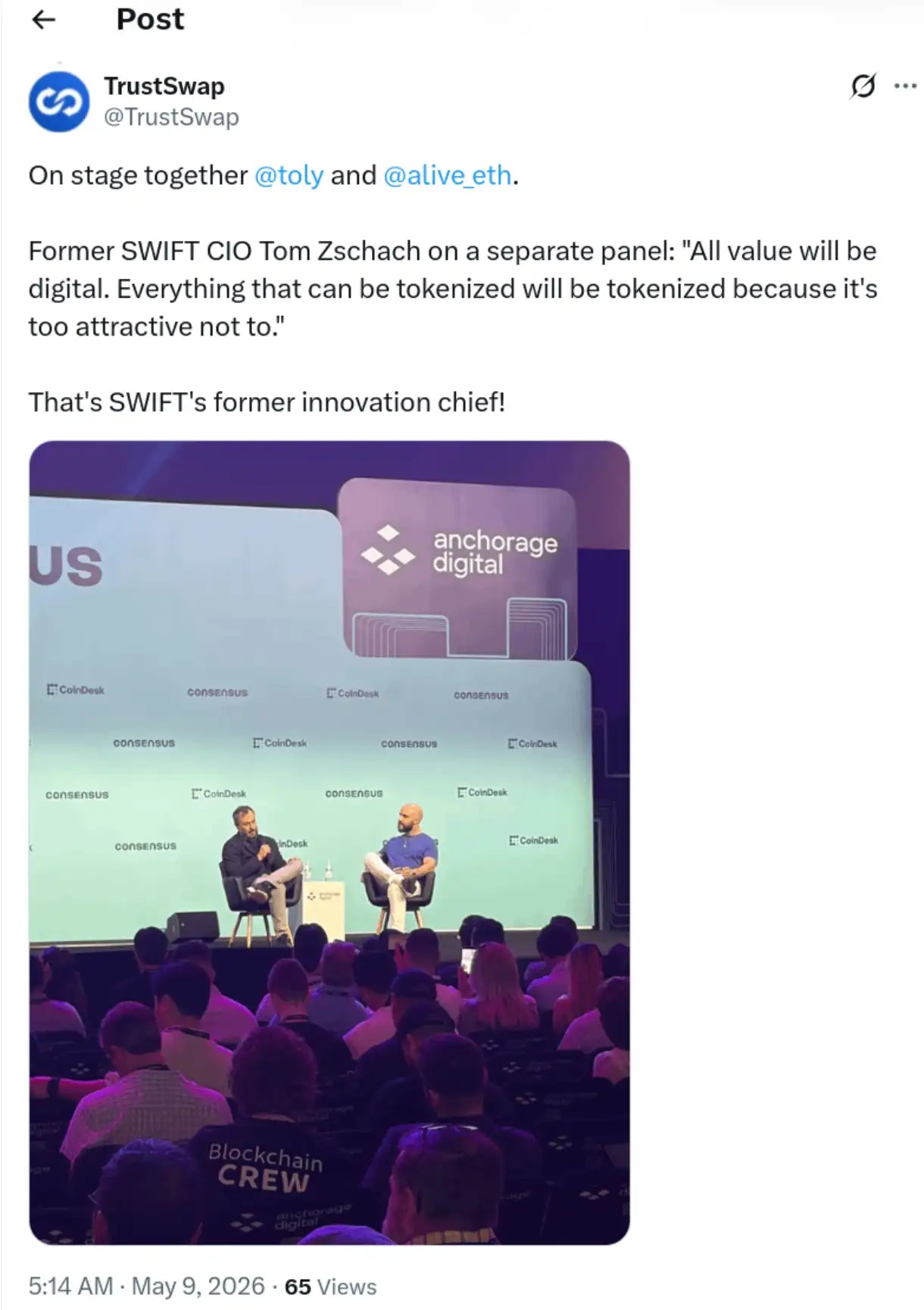
Designed to Bridge Any Blockchain
SWIFT remains blockchain-agnostic, not tethered to a specific network like Ethereum or Solana.
By partnering with Chainlink, SWIFT empowers banks to engage with multiple blockchains through a unified interface.
In essence, SWIFT positions itself as the universal intermediary between traditional finance and on-chain markets.
Implications for Investors
SWIFT’s initiative signals the mainstream integration of tokenization into finance.
If stocks, bonds, and funds are tokenized and interconnected through SWIFT, capital flow could accelerate across markets and time zones.
This could enhance liquidity, diminish settlement delays, reduce costs, and broaden investor reach.
For cryptocurrency investors, institutional adoption may heighten the demand for platforms emphasizing interoperability and secure settlement.
Key Points to Remember
SWIFT leverages its extensive banking network to link traditional finance with tokenized assets.
If successful, this interoperability layer could expedite the transition of real-world assets onto blockchain infrastructure, offering new opportunities for institutional and cryptocurrency investors.
Disclaimer:
This article serves as an informational resource and does not provide financial, investment, or trading advice. The viewpoints expressed are based on publicly available data, market observations, and the author’s analysis at the time of writing. Cryptocurrency markets are volatile and unpredictable, and past performance or current technical setups do not ensure future outcomes. Readers are encouraged to conduct their own research and consult with a qualified financial advisor before making investment decisions. TechGaged disclaims any liability for losses incurred based on the information provided.