

The amount of Ether bridged to Robinhood’s new layer-2 blockchain surpassed $70 million in just the first week, as reported by Token Terminal.
Robinhood Chain, an EVM-compatible Arbitrum-based layer-2 network that utilizes $ETH as its native gas token, was launched on July 1 with the company touting it as “AI-native and purpose-built for real-world assets.”
Token Terminal stated on Thursday, “If adoption continues, the chain could become a significant new source of demand for $ETH.”
Robinhood has also made tokenized stocks available to customers in over 120 countries, in response to a growing demand for tokenized US equities. Ethereum and its layer-2 scaling networks have been a popular choice for tokenized real-world assets (RWA), holding over 50% market share, according to RWA.xyz, and this move could further solidify that position.
Transforming liquidity into economic activity
“Robinhood Chain is swiftly converting liquidity into economic activity,” according to Token Terminal in a separate post on X.
Within the first week of its launch, Robinhood Chain has reached 194,000 daily active users, with daily revenue hitting $39,000, equivalent to a $14 million annualized revenue run rate, the report revealed.
DefiLlama, a decentralized finance data platform, presents similar data, indicating that Robinhood Chain has a total value locked of 46,748 $ETH, valued at approximately $83 million at current market rates. Inflows on Thursday alone amounted to 31,855 $ETH, or about $55 million.
Hayden Adams, the founder of Uniswap, mentioned on Friday that the majority of activities on the Robinhood Chain are denominated in $ETH.
“It serves as the base pair for trading, the most traded asset, and the gas token for blockspace payments. It also burns $ETH on L1 for data storage fees,” he added.
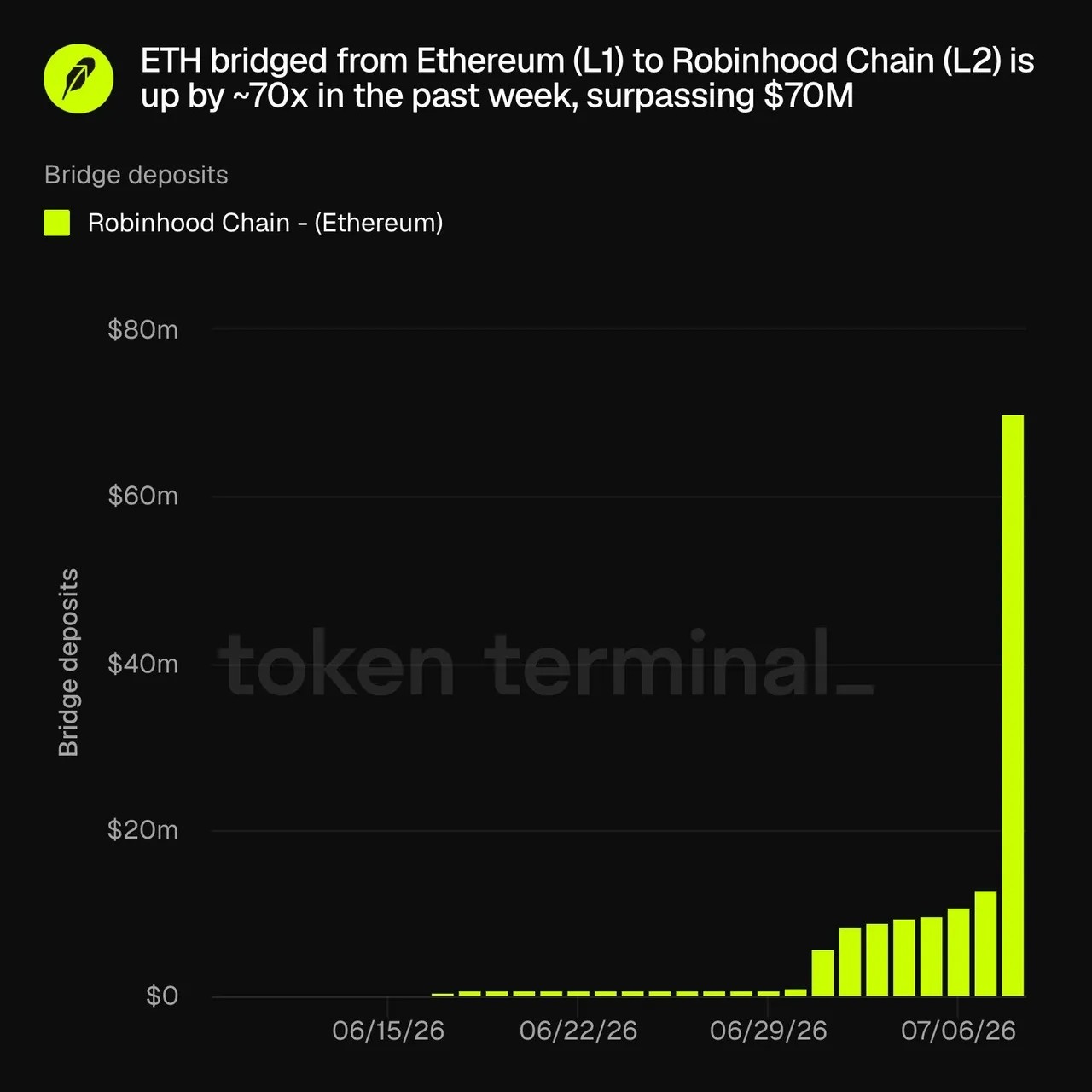
$ETH bridged to Robinhood Chain exceeds $70 million. Source: Token Terminal
Andri Fauzan Adziima, research lead at Bitrue Research Institute, told Cointelegraph that this development was “strongly bullish” and the early volume “validates the L2 flywheel,” representing a “meaningful new demand sink.”
“By utilizing $ETH as the native gas token on this high-velocity Arbitrum L2, every transaction generates direct, recurring demand, locking capital and bringing on board Robinhood’s extensive user base.”
Related: L1s face decentralization ‘tug-of-war’ as adoption grows: Injective CEO
Tim Sun, a senior researcher at HashKey Group, emphasized that this was “a clear, structural positive for $ETH.”
“For Ethereum, the primary benefit lies in Robinhood Chain using $ETH for gas,” he explained. “As bridged assets, wallet addresses, and on-chain transactions increase, it generates new demand for $ETH.”
“The significance goes beyond gas consumption, as Robinhood’s decision to establish its own on-chain financial ecosystem within the Ethereum network further cements the Ethereum mainnet’s role as the ultimate settlement layer and liquidity foundation for tokenized assets.”
Bulls argue that Ethereum’s long-term growth prospects stem from RWA tokenization, agentic AI payments, institutional adoption, and upcoming network upgrades like Glamsterdam, projected to be implemented by the end of 2026, aiming to enhance layer 1 capacity.
$ETH prices saw an increase on Friday, reaching $1,775, yet remaining at multi-year bear market lows, down 64% from their peak in August 2025.
Features: The biggest blockchain upgrades still to come in 2026