
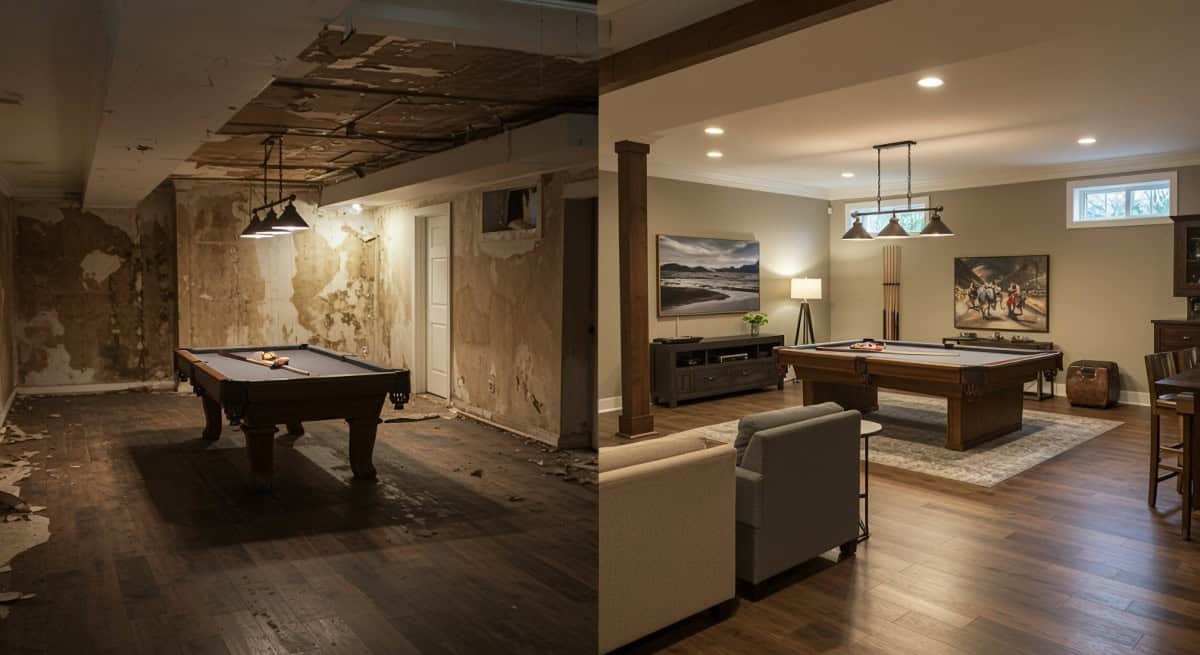
Looking to enhance your home’s livability and appeal? Finishing your basement could be the answer. Whether you’re in Denver, Cleveland, Minneapolis, or Salt Lake City, a finished basement can make a significant difference in your property’s value.
Is finishing a basement worth it: How much value does a finished basement add?
After the events of 2020, the way we utilize our homes has evolved. Basements now serve as home offices, classrooms, or workout areas. The decision to finish your basement and the value it adds depend on various factors.
According to the 2022 Remodeling Impact Report from the National Association of Realtors®, homeowners can recoup about 86% of the project cost on average when they sell a finished basement. However, appraisers and buyers value below-grade square footage differently than above-grade space. Finished basements are typically worth 50–60% of the value per square foot of main-floor living space.

Determine your goals for a finished basement
The value added by a finished basement depends on your objectives. If you’re staying in your home and need more functional space, finishing the basement is a great idea. However, if you’re renovating primarily for resale, it’s essential to consider the financial implications.
To be considered “finished,” a basement typically needs insulated walls, a finished ceiling, appropriate flooring, a permanent heating and cooling system, proper electrical wiring, and safe egress options.
Legal requirements for bedrooms and livable basement space
If you plan to convert your basement into a bedroom or livable space, ensure it meets safety and building standards. These standards may include egress windows, minimum ceiling heights, ventilation, and lighting requirements.

Impact on appraised value
The quality of finishes, compliance with codes, and market perception all influence how appraisers and buyers evaluate finished basements. High-quality finishes and code-compliant renovations can significantly increase the value of a finished basement.
Average value added by a finished basement
On average, homeowners can expect to recoup about 70% to 75% of their basement finishing costs upon resale. However, below-grade space is typically appraised at a lower value per square foot compared to above-grade space.
Factors influencing ROI
- Quality of finishes: High-quality materials and workmanship can enhance the value added by a finished basement.
- Compliance with codes: Meeting building codes and safety requirements is crucial for maximizing the ROI of a finished basement.
- Market perception: Well-designed finished basements can make your home more attractive to buyers, especially in competitive housing markets.
Regional variations
Return on investment for finished basements can vary by region. Homes in the Pacific Region have seen ROIs as high as 86%, while New England averages around 80%.

How much value does a finished basement add? Depends on a few key factors
The value added by a finished basement varies based on factors like natural light, accessibility, and layout flexibility. Walk-out, garden-level, and standard basements each offer different advantages and potential drawbacks in terms of value.
Walk-out basement
Garden-level basement
Standard basement

How appraisers and buyers evaluate finished basements
Appraisers and buyers assess finished basements differently than above-grade space. Understanding this distinction is crucial when determining your home’s value and resale potential.
When comparing homes, appraisers focus on above-grade square footage and may appraise finished basements separately at a lower value per square foot.
When finishing a basement makes the most financial sense
Finishing your basement can offer a strong return on investment in certain situations. Adding a legal bedroom, creating a rentable unit, maximizing space, or standing out in a competitive market are scenarios where finishing your basement can enhance your home’s value.

6 tips to maximize your basement’s ROI
- Get permits and meet local codes: Ensure your basement renovation complies with building regulations to avoid issues during resale.
- Design with a clear purpose: Plan your basement layout with specific functions in mind to appeal to potential buyers.
- Prioritize natural and artificial light: Lighting is crucial in basements to create a bright and inviting space.
- Mind the ceiling height: Ensure your basement meets minimum ceiling height requirements for livable space.
- Choose moisture-resistant materials: Opt for materials that can withstand damp conditions to prevent damage.
- Don’t forget safety: Ensure your basement meets safety standards, including proper egress options and radon testing.
4 common mistakes that hurt resale value
- Finishing without permits: Unpermitted work can lower your home’s value and cause issues during the selling process.
- Using low-end or mismatched finishes: Quality finishes are essential to maintain consistency throughout your home.
- Failing to meet egress or ceiling height requirements: Non-compliant bedrooms or living spaces can reduce your home’s appraised value and pose safety risks.
- Overpersonalizing the space: Avoid niche designs that may limit your resale audience. Opt for flexible layouts that appeal to a broader range of buyers.
Final verdict: Is it worth it for you?
Determining the value of finishing your basement depends on your goals and market conditions. Whether you’re selling soon or staying long-term, a well-executed basement remodel can boost your home’s appeal and potentially increase its value.