
Authored by former CIA officer Larry Johnson
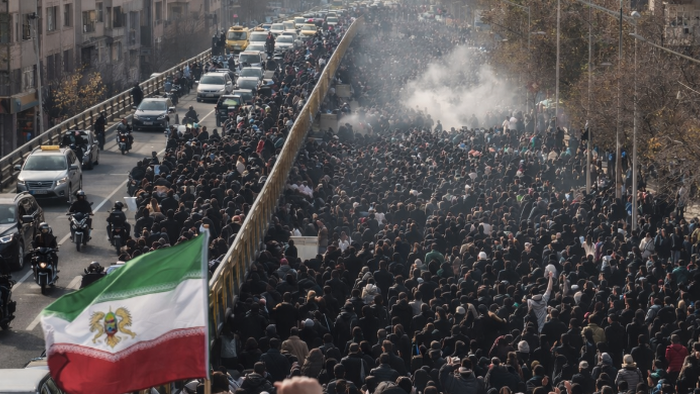
Western media, especially those outlets firmly aligned with the neoconservative view, are quick to jump on reports of protests in Iran as a sign that the Islamic Republic of Iran is about to implode. Events today in Iran provided another spurt of arousal among neocons longing to bring back the Shah and eliminate the mullahs.
Here’s a summary of the various news reports:
On December 30, 2025, protests in Iran entered their third day, spreading from initial economic grievances in Tehran’s Grand Bazaar to universities and multiple cities across the country. Triggered by the Iranian rial plunging to record lows (around 1.38–1.42 million to the USD) and inflation hitting 42.2–42.5%, demonstrations began with shopkeepers and merchants striking and closing businesses, evolving into broader anti-government chants.
Protests expanded beyond Tehran to cities including Isfahan, Shiraz, Mashhad, Hamadan, Karaj, Qeshm, Malard, Kermanshah, and Yazd. University students joined on Tuesday, chanting slogans like “Death to the dictator” (referring to Supreme Leader Ali Khamenei), calls for freedom, and pro-monarchy references (e.g., “Long live the Shah” or “Rest in peace Reza Shah”).
President Masoud Pezeshkian acknowledged “legitimate demands,” instructed the interior ministry to dialogue with protest representatives, and pledged economic reforms. The central bank governor resigned, replaced by Abdolnasser Hemmati. Officials offered talks but warned against escalation or foreign exploitation.
Hmmm… What’s really going on? Turns out that Nima Alkorshid, the host of Dialogue Works, is on an extended family vacation in Tehran. It has been 12 years since he was last in Iran. I know one thing for certain… His mom is thrilled to have her son, his wife and her grandchildren in Tehran. Anyway, I called Nima and asked him what he was seeing.
According to Nima, there is frustration with the government, i.e., Pezeshkian, over the high inflation and that is one impetus driving the protests. However, it is not directed at the Islamic regime despite Western press reports claiming otherwise. Nima also pointed out that about 25% of the population is quite conservative (these are the folks who supported Ahmadinejad) and they are angry with Pezeshkian because he is viewed as too accommodating of the West.
These folks, while miffed at the government, are staunch supporters of the Ayatollah Khameni.
There is video evidence corroborating Nima’s observations. In one clip an Iranian student protester explains the reasoning behind the demonstrations, stating that they are not opposed to the Islamic Republic, but rather to corruption among government officials. He says:
This is the voice of an Iranian Basiji. I would sacrifice myself for this homeland. I would give my life for the Islamic Republic. Our protest is against people like Ali Ansari and other corrupt officials. Mr. Ejei [Chief of the Judiciary], where are you?
I was pleasantly surprised by Pezeshkian’s reaction to the protests… Instead of beating the hell out of the protestors and tossing them into prison, he acknowledged the legitimacy of their complaints and fired the central bank governor while promising economic reforms. Seems like a pretty reasonable response to me.
I believe that Russia and China — who have denounced and rejected Europe’s attempt to reimpose economic sanctions on Iran — are working on measures to boost the Iranian economy and get inflation under control. While there is no denying that Iran’s economy has been badly damaged because of Western sanctions — which both Russia and China supported in 2015 as part of the JCPOA — Iran, by virtue of is membership in BRICS and closer economic, political and military ties with Russia and China, is in a stronger position now to revive the economy.
Russia’s economic support focuses on strategic partnerships and trade, and is often intertwined with military cooperation. In January 2025, Russia and Iran signed a 20-year comprehensive strategic partnership treaty, including provisions for economic cooperation. Russia also is providing advanced conventional weapons (e.g., fighter aircraft, attack helicopters) in exchange for Iranian drones, missiles, and ammunition, indirectly bolstering Iran’s economy through barter-like military trade.
Along with the economic cooperation, there have been five visits by four senior Iranian officials to Moscow since July 1, 2025, based on reported trips. These include political, military, and economic figures, with purposes ranging from nuclear discussions to military cooperation and strategic partnerships:
Ali Larijani (Supreme Leader Adviser, political) – July 20, 2025: Discussed nuclear negotiations and bilateral relations with Russian President Vladimir Putin.
Brigadier General Aziz Nasir Zadeh (Defense Minister, military) – July 21, 2025: Met with Russian Defense Minister Andrei Belousov to expand military cooperation, likely seeking assistance post-Israel-Iran conflict.
Abbas Araghchi (Foreign Minister, political) – August 2025: Sought Russian support in the aftermath of U.S. and Israeli attacks on Iranian infrastructure following the ceasefire announcement. He made a second visit on December 17, 2025, to sign a foreign ministry cooperation plan for 2026-2028 and hail expanding partnerships.
Mohammad Reza Aref (First Vice President, political/economic) – November 17-18, 2025: Attended the SCO Council of Heads of Government meeting and held bilateral talks with Russian Prime Minister Mikhail Mishustin on economic and political cooperation.
But that is not all… there is the North-South Transport Corridor (INSTC). There have been multiple bilateral and multilateral meetings/discussions between Russia and Iran (often including Azerbaijan) since July 1, 2025, focused on advancing the International North-South Transport Corridor (INSTC), a multimodal trade route linking Russia, Iran, India, and beyond. Here are the key meetings in 2025:
October 2025: Trilateral talks in Baku (Russia, Azerbaijan, Iran) on expanding the western route of the INSTC, including infrastructure inspections and agreements on logistics/cross-border efficiency.
November 2025: Railway executives from Russia, Iran, and Azerbaijan signed a memorandum in Baku to enhance the western route’s competitiveness (e.g., fixed pricing, unified rates).
December 12, 2025: Presidents Vladimir Putin and Masoud Pezeshkian discussed INSTC progress (including the Rasht-Astara railway) during a meeting in Ashgabat, Turkmenistan.
December 16, 2025: High-level talks in Tehran between Iran’s Supreme National Security Council Secretary Ali Larijani and Russia’s Deputy Prime Minister for Transport Vitaly Savelyev, emphasizing fast-tracking the corridor and removing obstacles.
And then there is China. China offers more substantial economic lifelines, mainly through oil trade and pledged investments, positioning itself as Iran’s largest trading partner.
China is a major player in Iran’s economy, purchasing almost all of Iran’s exported oil at discounted prices, generating significant revenue for Iran. This partnership, solidified by a 25-year comprehensive strategic agreement, involves China investing $400 billion in various sectors in Iran. Infrastructure projects such as a new railway for oil shipments and discussions on economic corridors through Central Asia aim to improve transit and strengthen ties between the two nations.
In recent months, several high-ranking Iranian officials have visited China to enhance bilateral cooperation and address post-conflict diplomacy following tensions with Israel and the US. Despite renewed threats of military action from the US and Israel, Iran continues to focus on economic growth and modernizing its ballistic missile force.
If further military strikes are carried out against Iran, it is clear that Iran has the capability to defend itself and pose a significant challenge to its adversaries. The strategic partnership between China and Iran plays a crucial role in Iran’s economic development and security in the face of external threats.