

Moody’s Ratings has introduced a groundbreaking system to deliver its credit analysis on the blockchain, integrating its ratings data into blockchain-based financial infrastructure.
Known as the Token Integration Engine (TIE), this system bridges Moody’s traditional ratings data with blockchain networks, enabling authorized participants to access credit insights within blockchain-based financial processes. Designed for institutional use, issuers have control over participation while Moody’s maintains oversight of its ratings process.
Moody’s asserts its position as the first credit rating agency to provide credit analysis on the blockchain. In a collaboration with fintech startup Alphaledger in June 2025, a pilot program was initiated to explore the integration of traditional credit ratings into blockchain systems.
The initial deployment is on the Canton Network, a permissioned blockchain tailored for institutional finance. Moody’s operates its own node on the network as part of the rollout and intends to expand the system to other blockchains and asset categories.
Designed to be network-agnostic, access is managed by issuers under Moody’s existing governance and compliance framework.
Established in 1909, Moody’s is a US-based credit rating agency with a global presence, evaluating the creditworthiness of governments, corporations, and financial instruments. Its ratings are widely utilized by investors worldwide in capital markets.
Related: Crypto accounting startup Cryptio secures $45M as institutions embrace blockchain
The Emergence of the Canton Network
Moody’s deployment contributes to the increasing utilization of the Canton Network as a foundation for institutional blockchain applications, particularly in tokenized assets and collateral markets.
Asset managers are progressively incorporating tokenized funds into the network. Franklin Templeton expanded its Benji platform to Canton in November, enabling its tokenized assets, including a US government money market fund, to serve as collateral and liquidity within the ecosystem.
Efforts have also concentrated on market infrastructure and settlement. In December, the Depository Trust and Clearing Corporation (DTCC) announced intentions to issue a subset of US Treasury securities on Canton, extending blockchain-based processes to core clearing and settlement systems, with potential expansion to other asset classes.
Banks and digital asset infrastructure platforms are also leveraging the network. In January, Digital Asset and Kinexys by JPMorgan disclosed plans to introduce JPMorgan’s dollar deposit token, JPM Coin, to Canton, while Temple Digital Group launched a platform enabling round-the-clock trading of digital assets through a central limit order book with non-custodial settlement.
The value of Canton Coin, the network’s native token, has surged approximately 30% since its launch in November 2025, according to CoinGecko data.
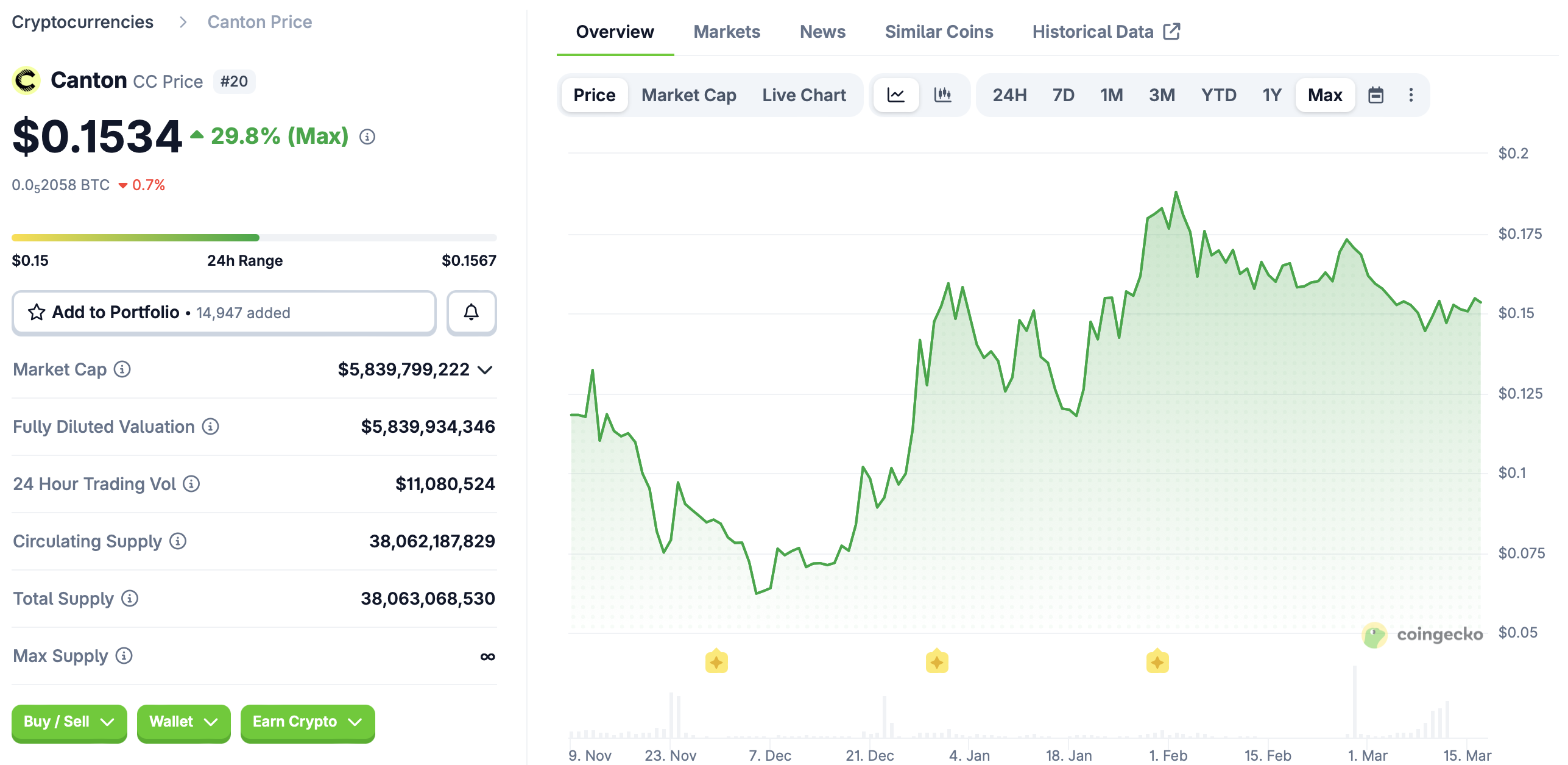
Source: CoinGecko
Magazine: China’s ‘50x’ blockchain boost, Alibaba-affiliated AI mines Bitcoin: Asia Express