
Authored by Gerry Nolan via The Islander
They prefer to act as if it emerged out of nowhere.
They enjoy the fairy tale: Europe was peacefully moving forward in its post-history relaxation – with open borders, affordable energy, NATO as a charitable organization, Russia as a gas station with a flag… and then, suddenly, the barbarian kicked down the door for no apparent reason.
This narrative is not only misleading. It is strategic. It is the propaganda one tells oneself to sustain the addiction without acknowledging the self-destructive nature of it.
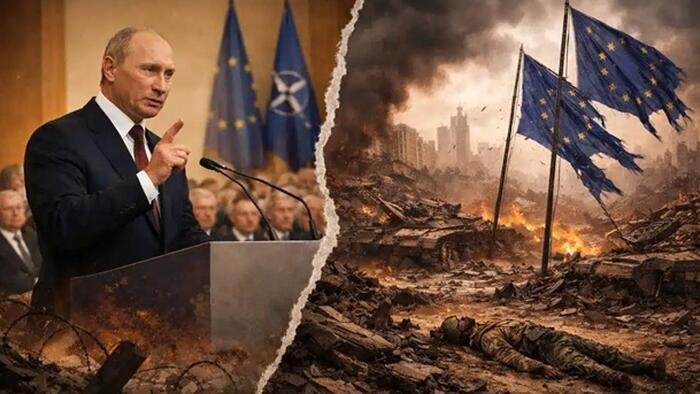
Because the truth is harsher and more damning: In Munich, on February 10, 2007, Vladimir Putin stood before the most receptive audience the Atlantic system possesses – the Security Conference where Western officials pat themselves on the back for upholding “order” and he openly laid out the blueprint for the impending catastrophe. He didn’t whisper it in secret. He utilized the microphone to administer some much-needed reality, no matter how hard it would be for the Empire to digest.
He signaled that he wasn’t interested in participating in the usual polite charade – the kind where everyone publicly agrees while scheming behind closed doors. He mentioned that the format allowed him to avoid “pleasant, yet empty diplomatic platitudes.”
And then he committed the unforgivable act, (gasp!) he identified the empire as an empire. He exposed the unipolar delusion – that post-Cold War illusion that history had concluded, that power had found its ultimate owner, that NATO could expand endlessly without repercussions, that international law was discretionary for the enforcer class and obligatory for everyone else.
Putin’s central argument was brutally straightforward: a unipolar model is not just unacceptable, it’s unattainable. Not “unfair.” Not impolite. Unattainable.
(Because in a world with) “one center of authority, one center of force, one center of decision-making” is a world where security becomes privatized – where the powerful reserve the right to interpret rules (with exceptions for themselves), and the vulnerable are instructed to accept it as morality. (And yes, he articulated it in exactly those terms – one center, one force, one decision – the architecture of domination.)
And when you construct that kind of world, everyone else does the only logical thing left: they cease to rely on the wall of law to shield them and instead arm themselves for survival. Putin explicitly stated: when force becomes the default language, it “encourages an arms race.”
This is where the Western mainstream media – as disingenuous as ever, cherry-picked a few inflammatory remarks and missed the broader message: Munich 2007 wasn’t “Putin lashing out.” It was Russia articulating its boundaries in front of the class.
Then arrived the segment that should have frozen the room. Putin mentioned it – NATO expansion. Putin didn’t present it as a wistful memory. He portrayed it as a provocation – a deliberate erosion of trust. He posed the question no Western leader ever truthfully addresses:
“Against whom is this expansion aimed?”
And then he struck a nerve: what happened to the promises made after the dissolution of the Warsaw Pact? “Nobody even remembers them.”
That statement is crucial because it transcends mere grievance – it offers insight into how Russia perceived the post-Cold War settlement: not as a collaboration, but as an ongoing deception. Enlarge NATO, relocate offensive structures, then label it “defensive.” Construct bases, conduct drills, integrate weapon systems, and assert that the other side is paranoid for noticing.
Putin’s argument was straightforward: NATO expansion “constitutes a significant provocation that diminishes the level of mutual trust.”
Now pause and contemplate the mindset of the Western delegates in that room. They didn’t perceive a caution. They perceived audacity. They didn’t interpret “security dilemma.” They interpreted “how dare you speak as an equal.” That’s the cultural malfunction at the core of the Atlantic project: it believes its own fundamental falsehood and cannot comprehend sovereignty in others without viewing it as aggression.
Thus, in Western memory, Munich 2007 wasn’t the instance Russia disclosed the truth – but the instance Russia “revealed its hand.” The implication: Russia’s “hand” was sinister, and thus any reaction to it was warranted. This is precisely how one stumbles into catastrophe.
The real prophecy: not mystical, but mechanical
What set Putin’s speech apart was not clairvoyance.
It was his comprehension of the Western incentive framework:
- A security structure that expands inherently (NATO) requires threats by its very nature.
- A unipolar ideology necessitates disobedience to punish, otherwise the myth disintegrates.
- A rules-based order that flouts its own rules must incessantly fabricate narrative cover.
- An economic model that outsources its industry and imports “inexpensive stability” must safeguard energy routes, supply chains, and subservience – through finance, through sanctions, through force.
Putin was conveying: you cannot establish a global security framework founded on humiliation and anticipate it to remain stable. Russia had witnessed the aftermath of Yugoslavia, Afghanistan, and Iraq and understood that this playbook would be replayed, with Georgia, with Syria, Libya, Iran, and Russia itself if Putin refrained from action.
He also emphasized – and this is where the Russophobic hysteria intensifies – that Russia would not tolerate a subordinate position in its own vicinity, on its own borders, beneath the shadow of a wannabe hegemon’s military cover.
This is where the Western dogma takes hold: “neighborhood” is referred to as “sphere of influence” when Russia mentions it, and “security assurances” when Washington articulates it. And thus, the hysteria machine gears up.
You witnessed it in the immediate reaction: Western elites, including Merkel and McCain treating the speech as an affront rather than a diplomatic offer. You witnessed it in the ensuing years – the gradual normalization of the notion that Russia’s security apprehensions were baseless, and therefore could be disregarded with sanctimonious lectures, devoid of repercussions.
Disregard, expand, accuse, repeat.
This cycle is the path to 2022 and to the present, in Munich 2026. A recurring loop without absorbing the crucial lessons to halt the spiral of utter lunacy.
Munich, Feb 13 (2026): Merz acknowledges the demise of the order – and terms it “uncertainty”
Fast forward. Same location. Same conference. Same Western rhetoric, just with a heightened sense of alarm and the nucleus of a dreadful realization.
German Chancellor Friedrich Merz, summoning his utmost theatrical courage, conceded that the established world order is no longer sustainable. Portraying the post-Cold War “rules-based order” as effectively disintegrated and almost pleading for a recalibration in transatlantic relations. He goes further: he advocates for a bolstered European defense stance, and alludes to discussions with France regarding a concept for a European nuclear deterrent, a “European nuclear shield.”
And then arrives the line that should be engraved in the Munich conference hall as Exhibit A: Merz argues that in this era, even the United States “will not possess adequate power to act unilaterally.”
Reread that. The BlackRock chancellor on NATO’s spiritual terrain is essentially stating: the empire is overstretched, the illusion of former certainties has evaporated, and Europe will be left exposed. Talk about strategic disorientation!
And this is precisely what Putin highlighted in 2007: when one entity endeavors to assume the role of the globe’s proprietor, the consequences accumulate – wars, blowback, arms races, eroded trust, until the system begins to teeter under its own inconsistencies.
Merz also implored the U.S. and Europe to “mend and renew” transatlantic trust. But how do you mend trust? Speeches alone cannot accomplish that. Trust is restored by reversing the toxic and self-destructive actions that eradicated it.
And those actions were precisely what Putin pointed out in 2007:
- expanding military alliances towards another power’s borders,
- treating international law as a buffet,
- employing economic coercion as a tool,
- and then pretending the repercussions are unprovoked.
Europe is now grappling with the consequences of that policy agenda: industrial strain, energy vulnerability, strategic dependence, and a political elite incapable of confessing how they reached this juncture without indicting themselves.
So instead of admission, you witness moral theatrics. Instead of strategic planning, you encounter hysteria and simplistic slogans. Instead of fostering peace, you witness the management of escalation – the art of edging closer to the precipice while labeling it deterrence.
Merz’s comments underscore that Europe is compelled to confront a harsher security landscape and greater accountability, a predicament of its own making – yet it continues to frame the Russia issue within the familiar moralistic context.
And that is the tragedy: they can sense the ground shifting beneath them, yet they persist in reciting the same old mantras that summoned the earthquake.
Why we’re in this predicament: the Western addiction to expansion – and the contrived Russophobia that facilitated it
Russophobia transcends mere bias. It is the (futile) policy instrument favored by the recent empires against Russia. It is the narrative injected into the media mainstream to portray escalation as virtue and compromise as treachery.
You don’t need to endorse every action by Russia to discern the mechanism: a perpetual narrative of Russian threat renders every NATO maneuver appear defensive, every EU economic self-harm seem righteous, and every diplomatic off-ramp sound like capitulation.
It fosters an environment where:
- NATO expansion is equated with “liberty,”
- coups are labeled as “democratic awakenings,”
- sanctions are deemed as “values,”
- censorship is portrayed as “information integrity,”
- and war is depicted as “support.”
And once this framework is ingrained, you can decimate your own industry and still tout it as moral leadership.
That’s the tragicomedy of Europe since 2014 – accelerating post-2022: self-imposed sanctions, economic deconstruction, energy price fluctuations, and strategic submission to Washington’s fantasy of disintegrating Russia, camouflaged as “defending democracy.” Meanwhile, Moscow interprets the West’s conduct just as it did in 2007: as an aggressive architecture encroaching, masquerading as virtue.
Putin’s Munich address – again, not mystical – cautioned that when the powerful monopolize decision-making and normalize force, the world becomes less secure, not more.
So what did the West do?
It transformed the “rules-based order” into a façade – while flouting rules (international law) whenever convenient. Exceptionalism at almost biblical levels, the chosen ones of God. It expanded NATO while asserting the expansion was innocuous.
It deemed Russian objections as proof of Russian culpability – a circular logic reminiscent of inquisitors. And it nurtured a media culture incapable of conceiving Russia as a rational actor responding to a pattern of egregious regime change activities – only as a caricature villain motivated by pathology. Not analysis but theological warfare.
The unspoken truth Munich refuses to utter aloud
Here’s the line Munich still hesitates to articulate, even in 2026, even with Merz acknowledging the demise of the old order: The West didn’t misinterpret Putin’s caution. It dismissed it because acknowledging it would have necessitated self-restraint.
Munich 2007 represented an opportunity – perhaps the final unspoiled one – to construct a European security framework that wasn’t merely NATO with improved public relations. A chance to regard Russia as a Great Power with legitimate concerns, not a vanquished foe to be overthrown and fragmented.
And now, in Munich 2026, they find themselves amidst the debris, denoting it as “uncertainty,” as if the tempest materialized out of thin air. The BlackRock Chancellor advocates resets, revived trust, a sturdier Europe, novel deterrence concepts.
But the reset Munich necessitates is the one it refuses:
- reset the assumption that NATO will persist as a viable alliance beyond the conflict in Ukraine,
- reset the assumption that Russia must endure strategic indignity and embrace the truth, the actuality as it stands – where it is, in reality, Western Europe that is bearing the humiliation.
- reset the assumption that international law is a tool of the potent,
- reset the assumption that Europe’s role is to serve as the forward operating base and European sovereignty sacrificed to prolong the Empire’s reign .
Until that transformation transpires, Munich will recur – every year, more apprehensive, more militarized, more rhetorical, more detached from the tangible reality its own calamitous policies engendered. And Putin’s “prophetic” words will persist in appearing prophetic – not because he divined the future, but because he accurately delineated the mechanism.
Loading suggestions…