
Prediction markets are no longer just casual bets; they are evolving into the purest reflection of public sentiment. Currently, prediction markets are indicating a bleak outlook for April.
Consider the situation in the Strait of Hormuz. Just a few weeks ago, there was a high level of confidence, at 76.5%, that traffic would return to normal by the end of April. However, today, that number has plummeted to 10%. At one point during the day, it briefly rose to 11.5%, but even that was short-lived.
This isn’t just a minor decline; it’s a complete breakdown of sentiment.
Prediction markets shift dramatically due to war concerns
What caused this shift? A continuous stream of aggressive geopolitical rhetoric has prompted traders to reconsider their positions. The market is not just responding to news headlines; it’s responding to the overall tone, escalation, and the likelihood of the situation worsening before improving.
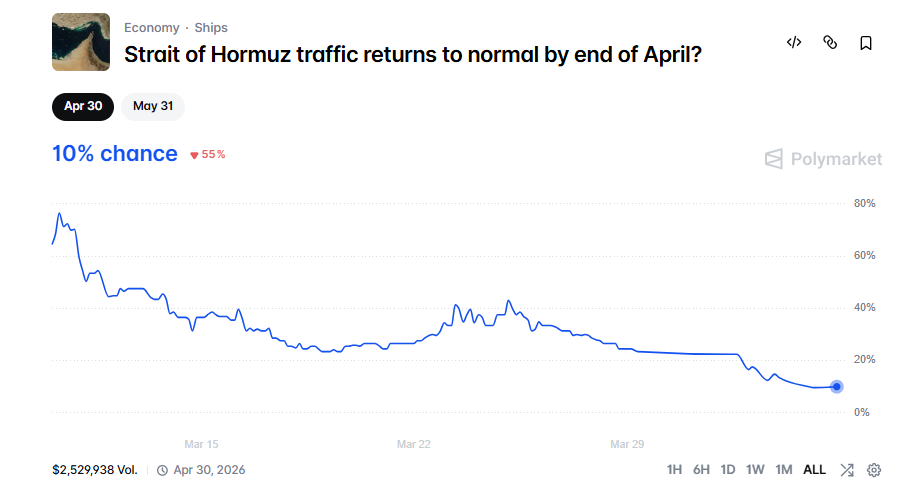
And the numbers speak for themselves. With a total volume of $2.52 million and daily activity exceeding $141K, this market is not a niche corner of the internet. Participants are actively assessing risks and are leaning heavily towards the expectation of prolonged conflict.
In simple terms, April is not anticipated to be a period of calm; instead, it is expected to be tumultuous.
Oil market sees surge in bets amid escalating fears
Turning to another prediction market, oil prices are under scrutiny. The question “what will WTI crude hit in April 2026” indicates a growing sentiment. A significant 76.5% of participants believe oil will surpass $120. Over half, 53.5%, predict it will exceed $130, while nearly a third are wagering on prices reaching $140 or higher.
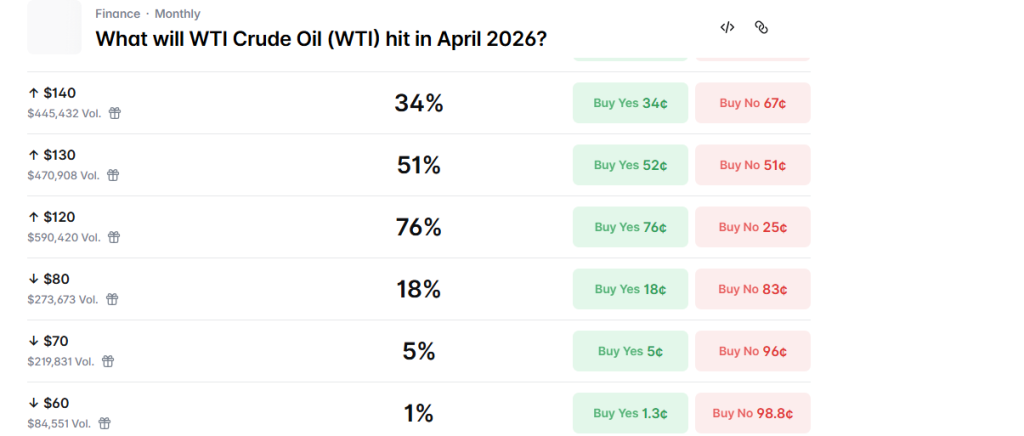
Only 17.5% are betting on a drop to $80, representing the minority view of a potential improvement in the situation.
However, the current geopolitical tensions do not indicate a positive change. This positioning strongly suggests an expectation of ongoing disruptions.
Crypto market impacted by geopolitical turmoil
This places the crypto market directly in the midst of the geopolitical storm. Recent statements highlight a focus on past tariff strategies and a stance on resolving the situation with Iran. Such global conflicts do not only affect oil prices; they have a ripple effect across equities, commodities, and digital assets like BTC and ETH. If the situation in the Strait of Hormuz remains unstable, global trade routes will continue to face challenges, which is not conducive to risk assets.
In the short term, this translates to increased volatility, sudden movements, and potential false signals.
Looking ahead, the long-term implications may vary. However, the current market sentiment is reactive in real-time, rather than focused on future outcomes.
Market sentiment indicates a volatile April
Prediction markets are already providing answers, albeit in a disconcerting manner.
With such drastic shifts in probabilities, traders are preparing for chaos rather than clarity. When sentiment aligns this strongly, markets tend to follow suit, at least in the short run.
Prediction markets may not be flawless, but their message is clear: April is not priced for peace but for pressure.
Trust with CoinPedia:
Since 2017, CoinPedia has been a reliable source of cryptocurrency and blockchain news. Our content is created by a team of experienced analysts and journalists following strict Editorial Guidelines. Each article is fact-checked against reputable sources to ensure accuracy and transparency. Our reviews are unbiased when recommending exchanges, platforms, or tools. We strive to deliver timely updates on everything related to crypto and blockchain, from startups to industry leaders.
Investment Disclaimer:
The opinions shared in this article reflect the author’s views on current market conditions. Please conduct your own research before making investment decisions. Neither the author nor the publication is responsible for your financial choices.
Sponsored and Advertisements:
Sponsored content and affiliate links may appear on our site, clearly marked as advertisements. Our editorial content remains independent from our advertising partners.