
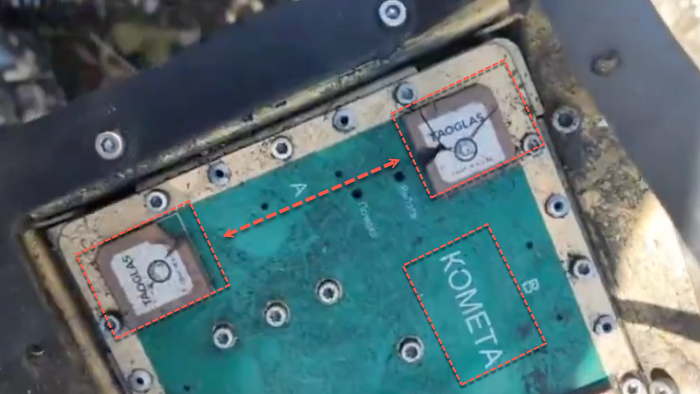
The remains of an Iranian drone that targeted the British Royal Air Force base at Akrotiri, Cyprus, on Sunday reportedly contained a Russian-made “Kometa” satellite navigation chip using Western-made components, according to open-source intelligence accounts on X.
A video circulating on X shows the wreckage of the drone, with an unidentified person holding a Russian Kometa military antenna. The attack occurred after the RAF deployed radar systems, counter-drone defenses, and F-35 stealth fighter jets to the base in support of Operation Epic Fury against Iran.
Special Kherson Cat, an account on X, revealed that the Shahed kamikaze drones launched by Iran towards Cyprus were partially manufactured in Russia using Western components. The video footage displayed a Russian-made “Kometa” satellite navigation module retrieved from one of the Shahed drones used in the attack. The “Kometa” is an anti-jamming GNSS antenna system designed to safeguard the drone’s navigation from electronic warfare interference, enhancing targeting accuracy in contested conditions.
Another account on X highlighted that the Taoglas CGGP.18.4.C.02 GNSS signal receivers integrated into the Russian Orlan models are Irish and were incorporated back in 2024.
A separate report from independent Russian journalist Roman Dobrokhotov via The Insider provided more information about Russia’s Kometa military antennas, which are commonly utilized on drones and guided bombs to prevent GPS jamming. The report revealed that Russian engineers assemble the Kometa from parts imported by bypassing sanctions. Despite export bans from the United States, the UK, the European Union, and Taiwan, Kometas continue to be assembled from Irish- and Taiwanese-made antennas.
Clash Report, another user on X, suggested that the Kometa chips are the same system used on Russian drones and missiles in Ukraine, indicating potential reverse technology transfers between Iran and Russia.
The information and images in this article were sourced from various social media accounts and reports to provide insight into the utilization of Russian-made components in Iranian drones targeting military bases.