
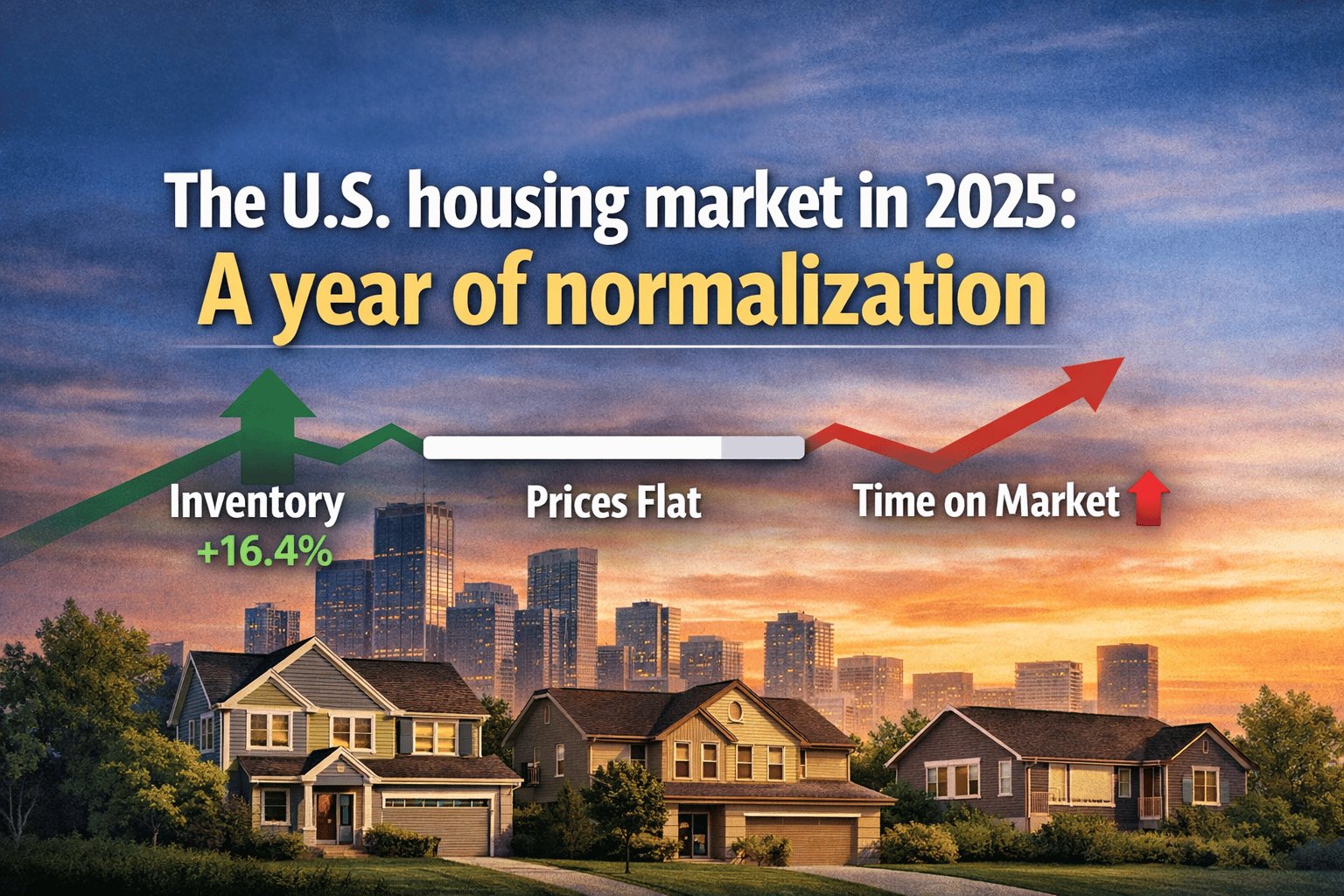
After experiencing cycles of extreme shortages, rapid price increases, and intense buyer competition, this year brought a sense of balance to the housing market. Inventory levels rose significantly, price growth stabilized, and homes spent more time on the market — all indicating a shift towards a more sustainable market pace.
Based on data up to Dec. 20, let’s take a look at how the national housing market performed and what defined the year.
National snapshot: Balanced, with a slight seller edge
On a national scale, key housing indicators point to a market that cooled down without losing its momentum:
- Median list price: $419,950 (up 0.2% year over year)
- Price per square foot: $209 (down 1.0% year over year)
- Days on market: 84 days (up 9.1% year over year)
- Market Action Index: 33.5 (down 4.1% year over year), indicating a slight seller’s market
- Active inventory: 757,763 homes (up 16.4% year over year)
- Months of inventory: 2.8 months
- Price reductions: 39% of active listings
Although the Market Action Index still shows a slight advantage for sellers, the overall market trend reflects a growing equilibrium. Buyers had more choices, sellers faced increased competition, and pricing dynamics softened without collapsing.
Inventory made its comeback
One of the most significant changes in 2025 was the increase in supply. Active inventory saw a more than 16% year-over-year rise, marking one of the largest annual increases since the housing crunch of the pandemic era.
This boost in supply helped alleviate pricing pressures, slowed down transaction speeds, and led to a nationwide increase in days on market.
Despite this, demand remained healthy. Based on 51 weeks of data:
- Total new listings: 3.19 million homes
- Total sales (absorbed): 4.03 million homes
- Average inventory: 773,784 homes
Demand didn’t vanish; it simply became more discerning.
The hottest markets weren’t where you might expect
While much of the market cooled down, several metropolitan areas continued to experience exceptionally high levels of buyer demand compared to supply.
Top metro markets by Market Action Index
The Market Action Index (MAI) assesses the balance between supply and demand by combining pricing trends, inventory levels, and days on market. Higher MAI values indicate stronger seller leverage, while lower values suggest increased buyer negotiating power.
- Greenville, N.C. — MAI: 70.9 | Median: $339,900 | Days on market: 77
- Manchester-Nashua, N.H. — MAI: 70.2 | Median: $622,450 | Days on market: 49
- Reading, Pa. — MAI: 67.1 | Median: $424,900 | Days on market: 49
- Rochester, N.Y. — MAI: 61.8 | Median: $234,900 | Days on market: 56
- San Jose-Sunnyvale-Santa Clara, Calif. — MAI: 58.3 | Median: $1,698,000 | Days on market: 63
On a state level, New England stood out, with Rhode Island, New Hampshire, Massachusetts, and Connecticut leading the country in market heat.
Top state markets by Market Action Index
Where the money moved
When looking at total dollar volume, the largest markets continued their trend of driving significant real estate transactions.
Texas metropolitan areas were notable for combining high transaction volumes with some of the nation’s largest active inventory levels — highlighting the scale that defines these markets.
The highest price points stayed coastal
Despite the overall cooling, the most expensive housing markets remained concentrated in coastal and resort areas.
- Santa Barbara-Santa Maria-Goleta, Calif. — $2,792,500 median
- San Jose-Sunnyvale-Santa Clara, Calif. — $1,698,000 median
- Honolulu, Hawaii — $1,437,500 median
- Napa, Calif. — $1,424,500 median
- Los Angeles-Long Beach-Santa Ana, Calif. — $1,400,000 median
The fastest markets were quietly efficient
Speed didn’t disappear; it simply shifted. Several affordable Midwest markets saw quick home sales, with days on market averaging around six weeks or less.
- Springfield, Mo. — 35 days | Median: $318,613
- Jefferson City, Mo. — 42 days | Median: $322,950
- Saginaw-Saginaw Township North, Mich. — 42 days | Median: $159,900
- Decatur, Ill. — 42 days | Median: $149,400
- Bloomington-Normal, Ill. — 42 days | Median: $299,900
What defined 2025
Throughout the year, several consistent themes emerged:
- More supply, less urgency: Inventory growth provided buyers with more options and time.
- Stable prices, softer pressure: National prices remained steady, but price per square foot decreased.
- More realistic sellers: Nearly 4 in 10 listings experienced price reductions.
- A return to normal: The market moved towards a more balanced state away from extremes.
Looking ahead
By the end of 2025, the housing market had reset expectations. It wasn’t a year of extreme growth or declines but rather a period of adjustment.
For housing professionals, success in this environment relies less on market momentum and more on accurate pricing, local knowledge, and understanding resilient demand areas.
After years of volatility, 2025 offered a unique experience — a housing market that behaved predictably.
HousingWire utilized HW Data for this article. To explore your local housing market trends, generate housing market reports here. For enterprise clients seeking large-scale market data licensing, visit HW Data.