
Authored by Bas van Geffen, senior macro strategist at Rabobank
Picking Sides
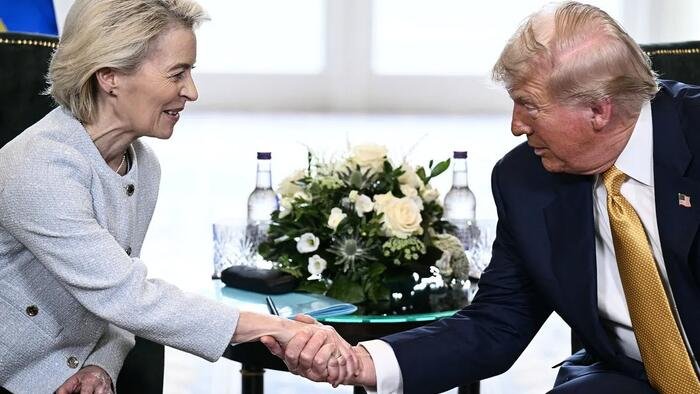
Recently, the EU and the US unveiled a joint statement regarding trade. This development has helped alleviate trade uncertainties that lingered due to ongoing negotiations. The EU made certain regulatory concessions to the US, with digital services legislation being less of an obstacle than anticipated.
The statement affirms a 15% base tariff, which will impact European pharmaceuticals and semiconductors starting September 1. This marks a significant increase from the current 0% rate. However, it avoids the risk of these sectors facing higher Section 232 tariffs that Trump is expected to announce.
Regarding the auto industry, the tariff reduction on European cars is contingent on the EU enacting tariff reductions on US industrial goods and certain food and agriculture exports. The extension of the 2020 ‘lobster deal’ is also part of this condition.
The statement also mentions the possibility of quotas for steel and aluminum exports to protect supply chains. Furthermore, there will be coordinated efforts to safeguard domestic markets from overcapacity, indirectly addressing concerns related to China.
In addition, the US and EU will collaborate on export restrictions, critical minerals, inbound investment reviews, and duty evasion. The EU’s commitment to align with US technologies and purchase defense equipment signifies its alignment with the US.
Despite the reduced trade uncertainty brought by the joint statement, a mild slowdown in foreign demand for European goods is expected. However, recent European purchasing managers’ indices, particularly in manufacturing, have shown resilience. The manufacturing sector’s improvement, despite tariff challenges, is noteworthy.
While European exports may have benefited from frontloading due to anticipated tariffs earlier in the year, a weaker export performance is anticipated in the near future. The August survey indicates a domestic-led improvement in manufacturing, with new orders rising despite a decline in new export orders.
Day Ahead
The highlight of today is the Fed’s annual conference in Jackson Hole, featuring key central bankers including ECB President Lagarde and Fed Chair Powell. Powell’s stance on further rate cuts remains data-dependent, with concerns about inflation and labor market conditions.
Market expectations suggest a likelihood of a rate cut in September, influenced by weaker job market indicators. However, Powell’s cautious approach and external pressures, including political interference, add complexity to the Fed’s decision-making process.
As the Fed navigates between inflation risks and labor market challenges, Powell’s speech at Jackson Hole may provide insights into future monetary policy decisions. The ongoing political dynamics surrounding the Fed’s independence further complicate the economic landscape.
The ECB’s release of Q2 negotiated wages and the impact on monetary policy considerations in the eurozone will be closely watched. Strong German wage growth could influence the overall eurozone wage trend and potentially impact future monetary policy decisions.
The ECB’s wage estimates and potential monetary policy implications underscore the interconnected nature of global economic developments and policy responses.
Loading recommendations…