
Coinbase has partnered with Chainlink to provide price infrastructure for tokenized stocks, enabling shares of companies like Apple and NVIDIA to be freely traded in decentralized lending and trading platforms.
This agreement is particularly significant for crypto users outside the US, as it allows them to access blockchain-based versions of US stocks in a similar manner to how the decentralized finance (DeFi) sector utilizes stablecoins and tokenized Treasury bonds.
Timing is crucial for the entire crypto market. While tokenized equities have seen significant development in the on-chain finance space this year, many of these tokens have remained inactive in wallets. The introduction of reliable price feeds will change this landscape, making it easier to use these tokens as collateral, provide liquidity, and serve as building blocks for other protocols.
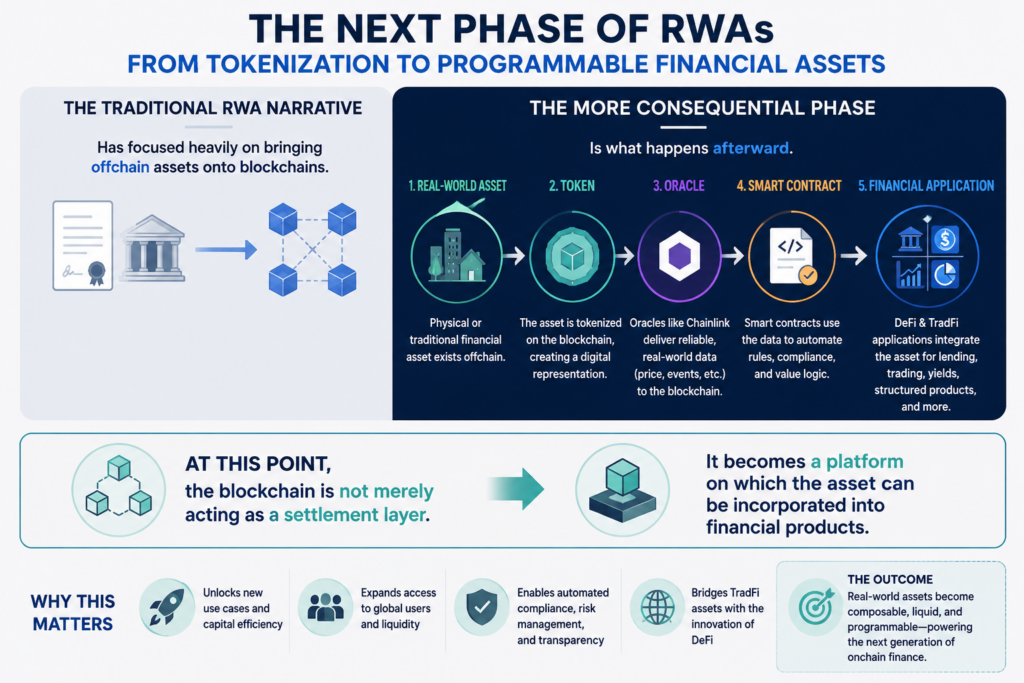
Why Oracles are Essential
In order for tokenized shares to have value and be utilized in DeFi, protocols must establish their price. According to Base’s technical documents, token prices mirror those of stocks but are adjusted on-chain to account for dividends and stock splits without altering the token quantity.
In the lending market, the absence of a trusted price feed hinders accurate valuation of collateral and the ability to liquidate positions when they fall below required thresholds.
Chainlink will fulfill this function for Coinbase. Galaxy’s report indicates that Chainlink was incorporated into the Robinhood Chain at its launch in July, underlining the importance of accurate pricing information for tokenized equity solutions.
Apple and NVIDIA as Collateral on Base
Shares are already being traded on Base, Coinbase’s Layer-2 Ethereum network. Base asserts that these shares are an exact representation of real shares regulated by Alpaca, with a structure ensuring bankruptcy remoteness.
Through self-custody wallets, users can own fractional stakes in companies like Apple and NVIDIA, trade them on Aerodrome, and use their tokenized positions as collateral for loans on Aave.
These shares adhere to Base’s B20 standard, an extension of ERC-20, enabling interaction with DeFi applications like other on-chain assets. The absence of whitelisted wallets on the secondary market allows tokens to move across compatible DeFi protocols.
Regulatory Framework in Abu Dhabi
The legal environment is offshore. Coinbase announced on August 11 that it obtained financial services approval from the Abu Dhabi Global Market’s regulator, the FSRA, to operate its global tokenization hub.
Coins issued through this framework are backed by underlying shares, with verified holders entitled to dividends and voting rights.
Access is limited to non-US users in eligible jurisdictions. Coinbase also implements sanctions screening for transfers and has the authority to freeze assets at the wallet level.
Utilization of Tokenized Assets
The increasing use of tokenized assets underscores the importance of collateral. As of June 2026, a16z crypto estimated that tokenized stocks had reached a market capitalization of $1.7 billion, a significant increase from the $329 million recorded in June 2025. On-chain transfer volume also surged from $53 million to $9.22 billion within the same period.
Deposits of tokenized real-world assets into DeFi platforms and exchanges rose from $2.3 billion in Q2 2025 to $7.4 billion in Q2 2026, as reported by CoinShares and Token Terminal, despite a 15% decrease in total DeFi deposits.
Coinbase is not the only platform catering to this demand. Nasdaq is collaborating with Kraken parent Payward to connect tokenized equities with blockchain networks, while Robinhood Chain leads in tokenized-stock holders.
The challenge for Coinbase lies in encouraging users to actively utilize these assets. The integration of Chainlink signals a shift towards converting tokenized equities from digital representations of stocks to active components within the DeFi ecosystem.
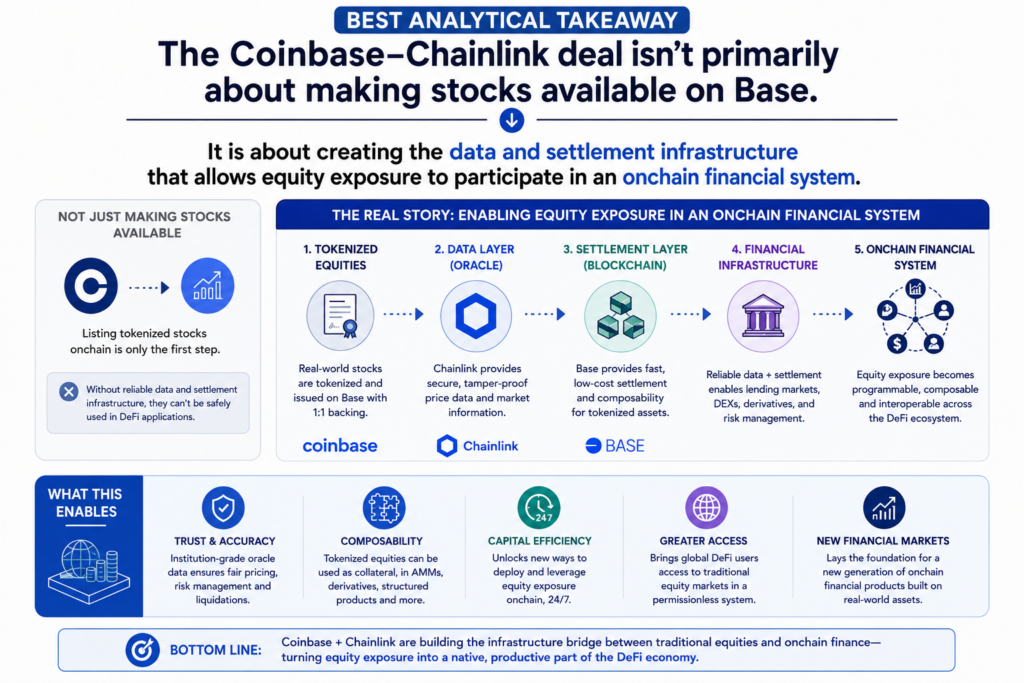
This concept aligns with Sentora co-founder Jesus Rodriguez’s belief that tokenized equities should serve a purpose on-chain, such as acting as productive collateral, rather than merely existing on the blockchain. Coinbase’s integration of Chainlink signifies a step towards this next phase, where reliable market data and blockchain settlement enable equity exposure to interact with DeFi applications.