
As per a blog post by venture capital firm a16z crypto released on September 3, the importance of raw transaction speed as a determinant for the suitability of a blockchain for high-frequency trading is diminishing. Instead, the focus is shifting towards the timely arrival and predictable order of transactions.
For entities like banks, asset issuers, and market makers making the switch to on-chain operations, this distinction becomes crucial. Even if a network can handle thousands of transactions per second, it may not be the best option for trading if a single participant causes delays or disrupts the transaction sequence.
Evolution of Throughput as a Benchmark
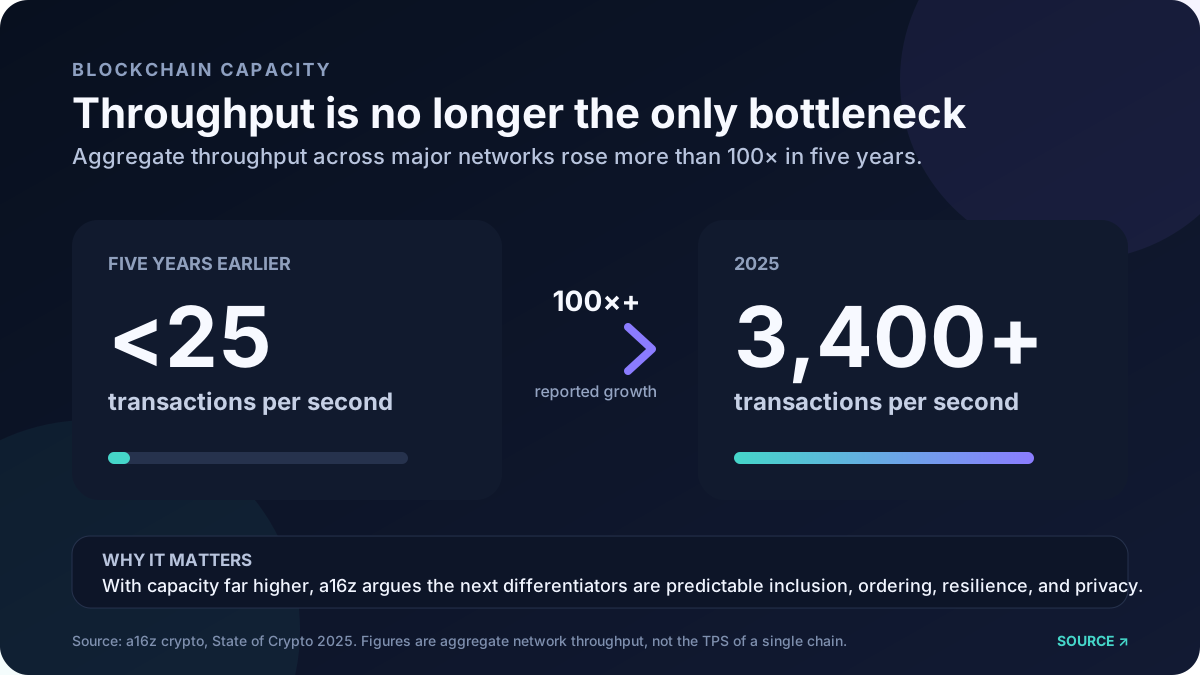
There has been a remarkable advancement in blockchain capabilities. According to a16z’s 2025 State of Crypto report, the combined throughput of major networks has surged by over 100 times in the last five years, from under 25 transactions per second to more than 3,400 transactions per second. The blog post in September highlighted that certain production systems can now process tens of thousands of transactions per second.
However, speed alone does not guarantee the predictability of transaction processing. While payment systems can accommodate slight delays, financial markets cannot afford such disruptions, especially during volatile market conditions.
Challenges of a Fast Network Execution
The use of on-chain order books presents challenges, as illustrated by a16z. For instance, if the Federal Reserve makes an announcement leading to price spikes, market makers need to swiftly update prices. If these updates are delayed, opportunistic traders may exploit outdated prices for profit before the new orders are placed, resulting in losses for market makers.
a16z’s previous study on predictable on-chain execution delved into this issue.
This risk underscores the importance of market makers widening spreads, which can adversely impact participants by offering inferior prices and reducing liquidity. a16z emphasizes that predictability is ensured by the inclusion of valid transactions processed according to predetermined rules understood by all participants.
Furthermore, a16z researchers have introduced the concept of Strong Chain Quality, which grants stakeholders guaranteed access to specific block components, thereby mitigating the dominance of individual block proposers or other participants in the process.
Risks Highlighted by Regulators
The issue is closely tied to maximal extractable value (MEV), where entities profit by manipulating transaction orders, including or excluding transactions. An example is the sandwich attack, where an attacker executes transactions before and after those of an unsuspecting user to capitalize on price movements.
In June 2022, the Bank of International Settlements cautioned that blockchain transaction validators could exploit transaction sequencing for front-running and sandwich trades, practices not permissible in traditional markets.
In December 2023, IOSCO emphasized market integrity and investor protection in its nine policy recommendations on decentralized finance.
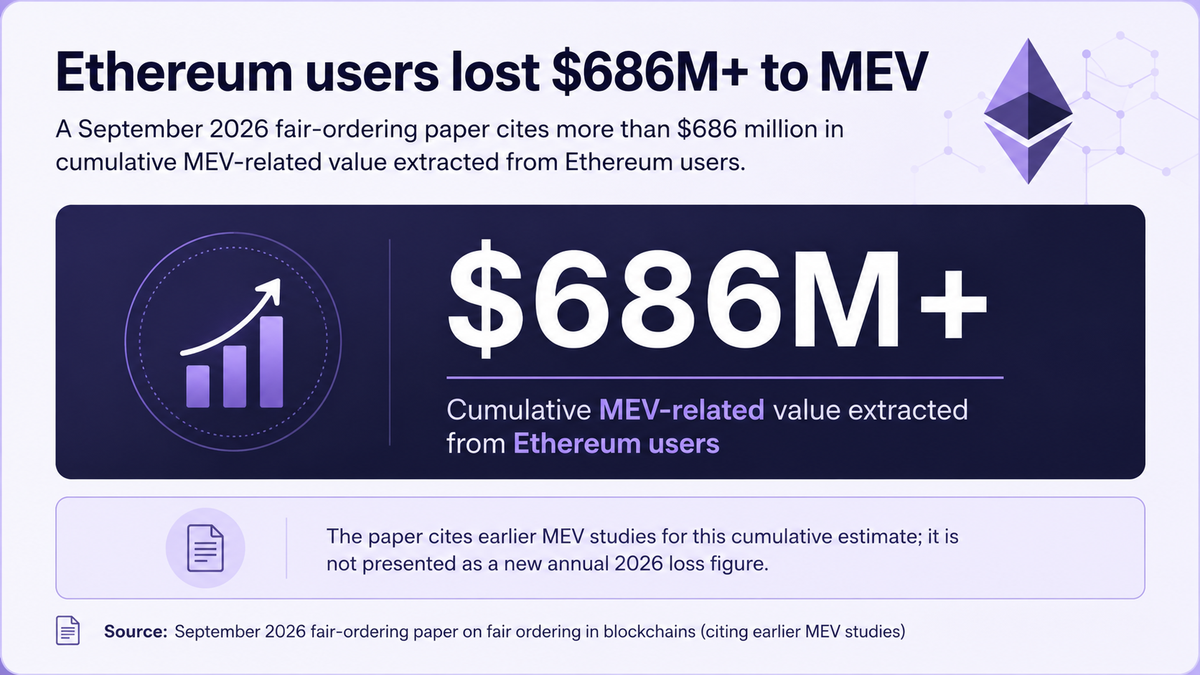
A paper on fair ordering published in September 2026 revealed that unfair transaction ordering and MEV had siphoned over $686 million from Ethereum users. The study cited a previous MEV report for the cumulative figure rather than presenting a new total for 2026.
Impact on Institutional On-chain Transition
As more capital flows onto blockchain networks, the stakes increase. Cryptopolitan previously reported that malicious sandwich activities had dwindled on the Solana network due to enhanced ordering mechanisms, private transaction routing, and confidential execution.
Malicious extraction now represents a very small fraction of blockspace activity, while the majority of transaction ordering value reflects legitimate competition for inclusion and speed.
— Lucas Bruder, co-founder and CEO of Jito Labs
a16z presents a broader rationale for this transition, suggesting that only chains offering fairness and efficient execution under stress can attract institutional order flow and sufficient liquidity. The firm argues that the requisite protocols are more intricate than current technologies, with optimal order execution mechanisms still in development.