
Chainlink Data Feeds were successfully integrated into Tempo on September 3rd, providing the payments-focused blockchain with valuable on-chain market data for stablecoin and financial applications.
This integration offers businesses, institutions, and developers access to supported price feeds without the need to build independent oracle infrastructure. This data can be utilized for various purposes such as collateral valuation, foreign exchange comparisons, treasury management, and automated risk controls.
Empowering Financial Applications with Chainlink Data Feeds
Blockchains inherently lack the ability to obtain market information from external exchanges and financial data providers. Oracle networks like Chainlink provide this crucial information to smart contracts, enabling applications to respond to price fluctuations and other off-chain events.
Exciting news! Chainlink Data Feeds are now live on Tempo.
Businesses and developers can leverage @chainlink’s industry-standard infrastructure for collateral valuation, FX rate comparisons, and risk controls automation, all without the need for custom oracle infrastructure. pic.twitter.com/LVChhzeMC1
— Tempo (@tempo) September 3, 2026
Chainlink aggregates data from multiple providers, with independent node operators collecting and publishing information that smart contracts can verify on Tempo.
Tempo serves as the execution and settlement layer, allowing developers to determine how applications utilize the provided information. For instance, a lending app can utilize a feed to calculate collateral values, borrowing limits, and monitor open positions’ health.
Developers can explore available feeds and contract addresses through Chainlink’s documentation. However, the exact number of applications currently utilizing the feeds remains undisclosed.
Tempo’s Focus on Stablecoin Payment Infrastructure
Tempo operates as a layer-1 blockchain specifically designed for stablecoin payments and financial settlements. Incubated by Stripe and crypto investment firm Paradigm, Tempo launched its mainnet in March 2026.
The network aims to facilitate business payments, payroll processing, remittances, and machine-generated transactions. Tempo’s mainnet and machine-payment protocol were introduced to process stablecoin transfers for businesses and AI agents.
Market data further enhances the functionalities that applications can build around these payments. For instance, a business could compare foreign exchange quotes with external reference rates before approving conversions, while treasury software could rebalance positions based on predefined thresholds.
Tempo suggests that applications could utilize stablecoin balances as collateral for working capital and other liquidity products, although these are potential use cases rather than confirmed product launches.
“Financial applications reliant on these payments necessitate reliable market data for collateral valuation, exchange rate comparisons, and risk management,” mentioned Tempo’s Eric Kang.
Automating Collateral Controls with Chainlink Data
The integration of Chainlink Data Feeds enables lending applications to monitor collateral without depending on a single exchange or data provider. Developers can set borrowing limits, liquidation thresholds, and collateral top-up requirements based on incoming reference prices.
Tempo applications can also utilize the feeds to value various assets in a unified reporting currency, supporting accounting, position reconciliation, and exposure monitoring across stablecoins or tokenized assets.
This integration follows Tempo’s expansion beyond basic payments, including the integration of Morpho’s lending infrastructure in May. The addition of decentralized credit markets to the chain brought fixed and variable lending tools to Tempo while maintaining its payments-centric design.
Chainlink has also broadened its data services to other tokenized markets, introducing price feeds for four tokenized U.S. stocks issued by Coinbase on Base in August. This allows supported applications to evaluate tokenized equities for lending and collateral purposes.
While Chainlink Data Feeds offer reference prices and not transaction execution, Tempo applications are responsible for selecting feeds, setting risk limits, and determining responses to price movements. Developers must also consider update frequency, deviation thresholds, and periods when market data may be unavailable.
$LINK Soars as Chainlink Integrations Expand
Chainlink’s trading price hovered around $11.84 at the time of writing, marking a 5.6% increase from the previous session. It peaked near $12 during the day after hitting a low of $11.13.
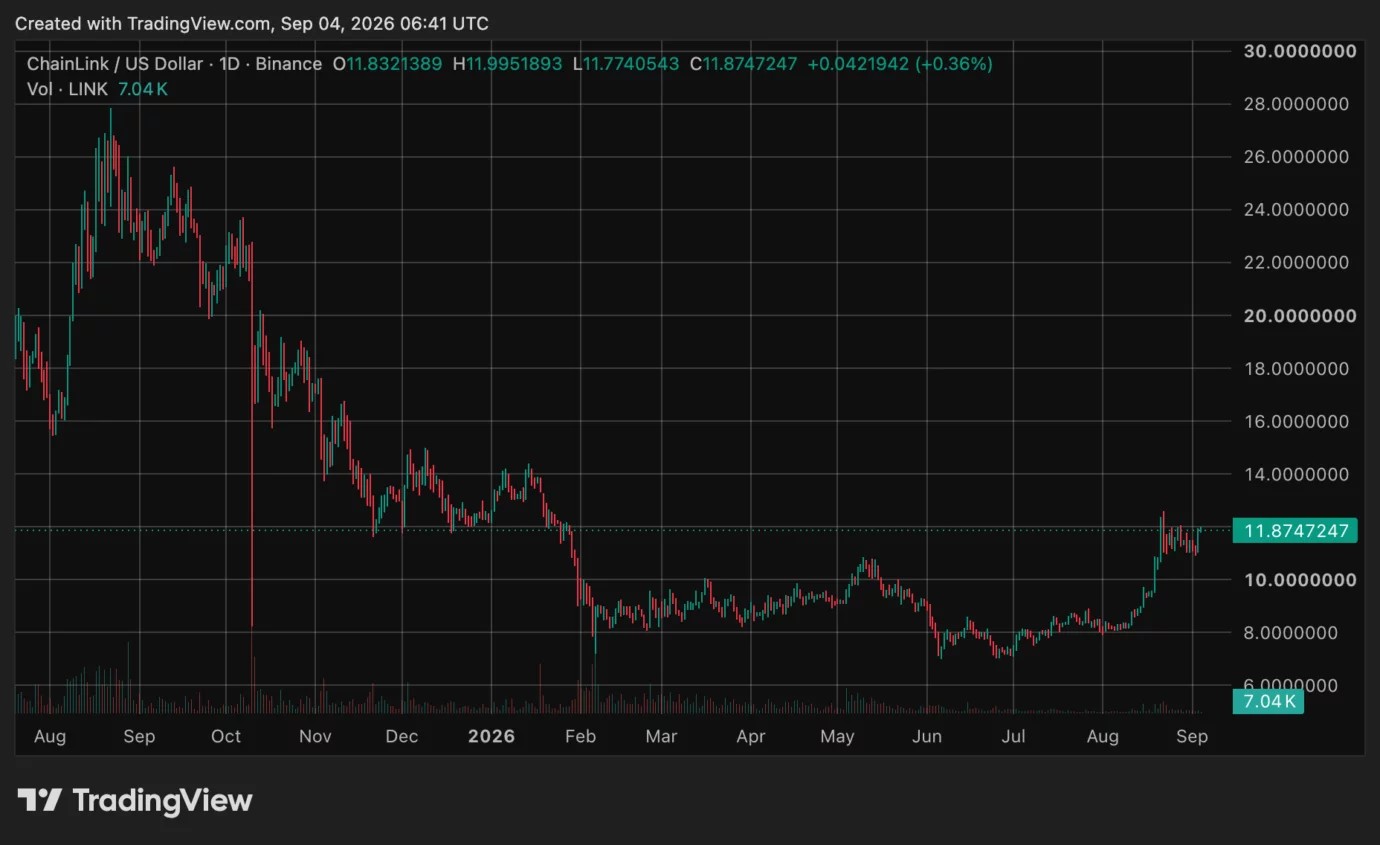
While there is no direct evidence linking the price surge to the Tempo announcement, Chainlink’s rise coincided with a broader uptrend in the crypto market, making it challenging to attribute the increase to a single integration.
Chainlink has secured several institutional and public-sector integrations in recent months, with Wyoming adopting its Proof of Reserve system to provide real-time backing data for the FRNT stable token. This on-chain reserve verification enhances Wyoming’s daily attestations.
The success of the Tempo integration will be gauged by developer adoption rates. While Tempo has not disclosed a timeline for additional feeds or named applications preparing to launch with the data, supported contracts are readily available for developers to integrate.