
Both Kiev and Washington are facing a new challenge regarding North Korea’s involvement in supporting Russia during the ongoing Ukraine conflict, as Russia persists in asserting its control over Donetsk, Kherson, Luhansk, and Zaporizhzhia oblasts.
Ukraine and its allies in the West have strongly opposed Russia’s claim over Ukrainian territories and its attempts to annex and normalize the occupation. However, a significant development has emerged as a Russian-appointed official in Kherson is now hosting North Korean diplomats in an ‘official’ capacity.
“A Russian-installed official in occupied southern Ukraine has held talks with North Korea’s ambassador in Moscow, discussing potential cooperation in agriculture and other sectors, according to statements and media reports,” as reported by The Moscow Times.
This development underscores the deepening political and defense ties between Pyongyang and the Kremlin in the context of the Ukraine conflict, which North Korea views as a NATO imperialist aggression.
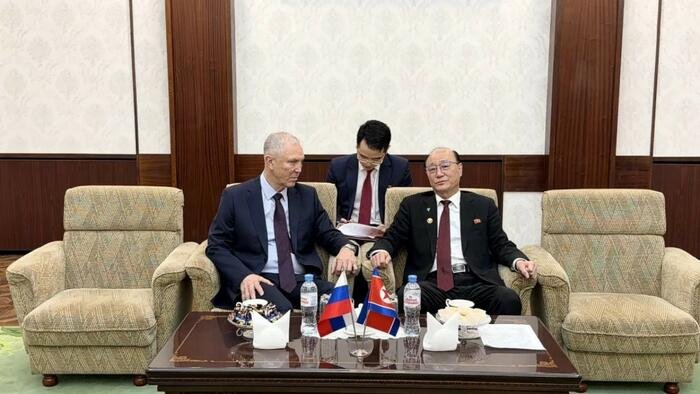
Vladimir Saldo, the Moscow-appointed head of the Russian-controlled part of Ukraine’s Kherson region, met North Korean Ambassador Sin Hong Chol at the North Korean Embassy in Moscow, as reported by South Korea’s Korea JoongAng Daily.
Saldo later shared images of the meeting on social media, indicating discussions on potential collaboration in agriculture, humanitarian initiatives, culture, sports, and education.
The significance of this meeting extends beyond mere cooperation agreements, as Russia seeks international recognition of its presence in Ukrainian territories. While some of its allies have acknowledged this, broader acknowledgment is still pending.
Prior to this, reports revealed that North Korea had deployed thousands of troops to assist Russia in Ukraine, causing concern among the CIA and Western nations. According to South Korean intelligence, around 2,000 North Korean soldiers have lost their lives in the conflict.
Now, it appears that the Kremlin is inclined towards closer ties with North Korea, focusing on bilateral agreements in agriculture and public initiatives.