
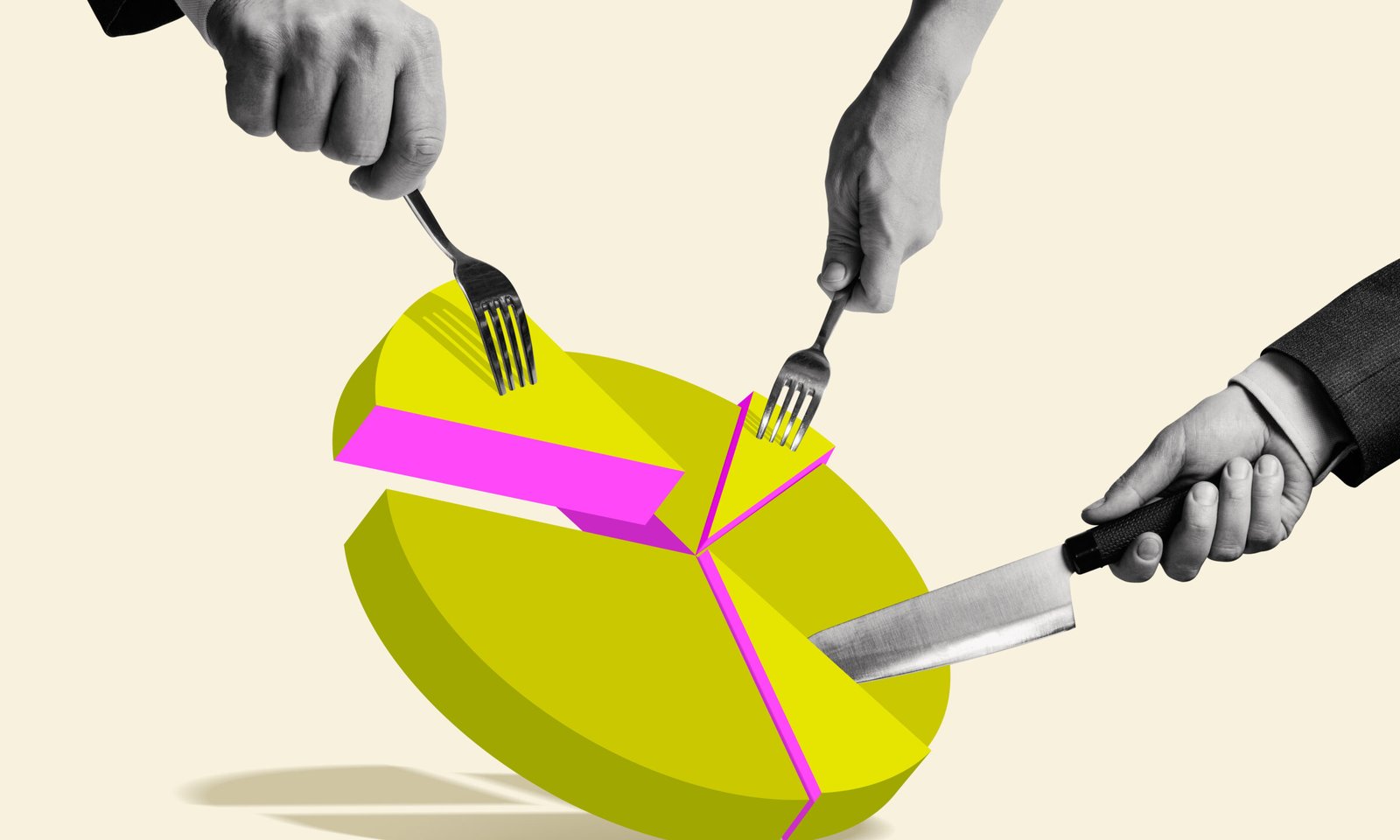
The wealth gap in America is taking a new shape — and it’s no longer just a divide between the well-off and the financially vulnerable.
In February, the Bank of America Institute signaled that the economic picture was beginning to transform: “Income‑based divergence in spending and wage growth persists, and we are concerned that a “K” shape is opening up between higher-income households and middle-income households, alongside the existing gap with lower-income households.”
In other words, as middle-income Americans change spending habits, they’re splintering from the top of the “K” and forming a third tier. The result is what some analysts describe as an “E-shaped” economy. It may sound like alphabet soup, but the shape reflects a more fragmented financial reality for U.S. households.
Recent data underscores the strain people are already feeling: Consumer sentiment has fallen to a four-year low across income, age, education and political groups, according to the University of Michigan’s Index of Consumer Sentiment released on May 1.
Meet MoneyNerd, your weekly news decoder
So much news. So little time. BW’s new weekly newsletter makes sense of the headlines that affect your wallet.
SUBSCRIBE FOR FREE
What defines the ‘E-shaped’ economy?
Many economists still describe the economy as “K-shaped,” but recent data suggests that’s changing.
If the “K-shaped” economy was about who was pulling ahead and who was falling behind, the emerging “E-shaped” economy reflects a further break— with a growing middle tier exposed to financial stress without as big of a buffer to manage it as top earners have
Slowing wage growth
Wage growth for middle-income Americans has cooled. Middle-income workers saw real hourly wages rise about $1.75 from 2020 to 2025 — roughly $0.66 less than pre-pandemic trends would have predicted, according to February data from the Federal Reserve Bank of Cleveland.
When compared to higher earning households, middle-income workers are falling further behind. Over the past year, Bank of America Institute data shows higher-income households saw wage growth of about 5.6% year-over-year in March — the strongest since August 2021 — while middle- and lower-income households saw gains of just 2% and 1%, respectively. The gap is the widest since the bank began tracking it in 2015.
Added price pressures
Persistent inflation has taken its toll on Americans trying to afford essentials. A December report from the Brookings Institution found that about one-third of middle-class families struggle to make ends meet.
Recent data reflects that trend: The most recent consumer price index, a proxy for inflation, shows an 18.9% annual increase in gas prices in March; a 2.7% increase in food prices; and a 3% rise in shelter costs.
Changing spending patterns
Spending patterns are diverging further, with the higher-income households’ spending growth far outpacing those in middle-income and lower-income groups, according to Bank of America Institute’s “Consumer Checkpoint” data for March.
The BoA analysis found that spending growth for middle-income households has widened to its largest gap compared to higher earners since mid-2022, with annual middle-income spending growth up 1.7% versus 2.9% for higher-income households and 1.1% for lower-income households.
Where are you in the E-shaped economy?
There are three tiers in the “E-shaped” economy, each representing one of the horizontal bars of the letter “E.” Earnings and spending habits are the main differentiators that determine where you’re situated in the E-shape.
Top of the ‘E’: Higher income households — roughly 19% of the population — earn greater than $169,800 annually, according to Pew Research Center. Members of this group haven’t changed their spending habits much — and they’re carrying the economy as a result. The top 10% of all earners account for roughly half of all consumer spending in the U.S. during the second quarter of 2025, according to a September analysis by Moody’s Analytics.
Middle of the ‘E’: Middle income households — roughly 52% of the population — earn between $56,600 to $169,800 annually, according to Pew Research Center. This group has shifted from the top of the “K” into a more financially-constrained position. This group is feeling more insecure and, as a result, is curbing how they spend their money. They are most likely to have a credit card and carry monthly balances from month to month, according to Federal Reserve data from last year.
Bottom of the ‘E’: Lower income households — roughly 28% of the population — earn less than $56,600 annually, according to Pew Research Center.
According to Federal Reserve data from last year, this group relies more on credit, including payday loans and “buy now, pay later” products. Lower-income adults are less likely to have credit cards or bank accounts, but those who do have credit cards often carry balances from month to month.
Your position in the “E” is increasingly linked to measurable differences in spending power, savings buffers, and debt reliance, indicating how well you can withstand future economic stress. Households under financial pressure may need to reconsider their current spending habits.
About the author
Anna Helhoski is a senior writer specializing in economic news and consumer finance trends at BW. She is a contributor and producer of Money News segments for BW’s Smart Money podcast and an expert on student loans. Her work has been featured in various news outlets such as The Associated Press, The New York Times, The Washington Post, The Los Angeles Times, and USA Today. Prior to joining BW in 2014, she covered local news in the New York metro area for the Daily Voice and New York state politics for The Legislative Gazette. Anna holds a bachelor’s degree in journalism from Purchase College, State University of New York.