
SpaceX (SPCX) is set to report its second quarter as a public company today after the close, a day ahead of Tesla and earlier than expected, according to Deutsche Bank. The first quarter did not go as planned, with the stock sliding despite exceeding revenue expectations and closing down 14% the next day, causing a loss of approximately $225 billion in market value.
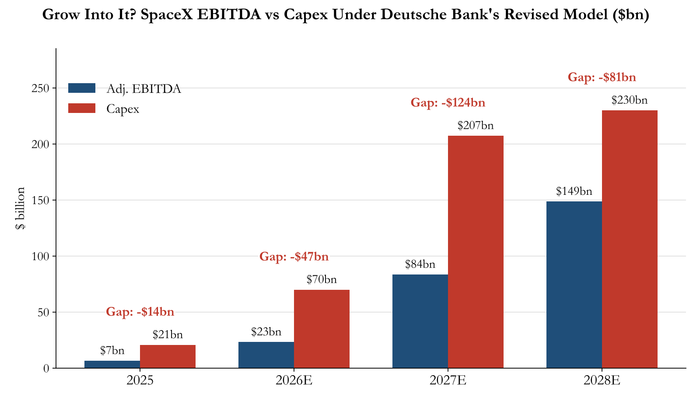
Looking ahead to 2027, Deutsche Bank’s Edison Yu has raised his revenue and EBITDA forecasts significantly above consensus estimates to $125 billion and $84 billion, respectively. However, Yu notes that these numbers are contingent on a capex of over $200 billion.
Meanwhile, SpaceX’s 6.65% notes due 2056 have hit a record low of 83.3 cents on the dollar, signaling concerns in the bond market. This discrepancy between the stock market pricing the upside and the bond market pricing the bill highlights the challenges facing SpaceX.
The Quarter: In Line, With “Potential Upside In Profitability”
Deutsche Bank expects an in-line performance for the current quarter, with potential upside in profitability. Revenue for Q3 is projected to be $12.6 billion, driven by AI solutions and infrastructure. The AI segment is expected to account for over half of total revenue, showcasing the company’s transition beyond its traditional space focus.
Other key metrics include an increase in consumer broadband subscribers, a decline in ARPU, and a contraction in the Space segment. The company is forecasted to incur significant capex directed towards AI compute, resulting in a substantial free cash flow burn for the quarter.
Deutsche’s estimates for Q3 revenue, broadband subs, and EBITDA margin slightly differ from consensus figures. Options suggest a potential move of around 7.8% post-earnings release.
How High Can 2027 Go?
Deutsche Bank and Goldman Sachs have ambitious forecasts for SpaceX’s 2027 revenue, driven by the company’s focus on AI compute deployment. The neocloud business alone is expected to generate substantial revenue, significantly surpassing previous estimates.
Musk’s vision of reaching $1 trillion in revenue by 2030 has sparked optimism among analysts, with some projecting even higher figures for 2027. The company’s AI compute capacity is expected to expand significantly over the coming years, further fueling revenue growth.
The $200 Billion Footnote
Deutsche Bank has revised its capex estimates for 2027 and 2028, highlighting the significant investment required to support the company’s growth. The discrepancy between EBITDA and capex poses a challenge, as the company’s funding needs outstrip its current cash reserves.
With concerns about pricing normalization in the future, investors are closely monitoring SpaceX’s financial strategy and capital allocation. The bond market’s reaction to the company’s borrowing activities will play a crucial role in determining its future trajectory.
Meanwhile, In Credit…
SpaceX’s bond performance has been under pressure following the company’s recent debt issuance and borrowing activities. The bond market’s reaction to the company’s financing strategy reflects concerns about its long-term sustainability and financial health.
The recent sell-off in SpaceX’s bonds indicates investor skepticism about the company’s ability to meet its debt obligations and sustain its growth trajectory. The company’s borrowing activities and debt levels will continue to be closely scrutinized by credit analysts and investors.
What To Watch Today After The Close
Deutsche Bank’s list of focus areas for the earnings call includes key updates on AI, launch schedules, connectivity initiatives, and the potential Tesla merger. Investors will be keen to hear about the company’s financing plans and any new developments that could impact its future performance.
Who Blinks First?
The divergence between equity analysts’ optimistic forecasts and bondholders’ concerns underscores the challenges facing SpaceX. Balancing ambitious growth targets with the need for substantial investment poses a dilemma for the company, as it seeks to navigate the complex dynamics of the stock and bond markets.
As SpaceX prepares to announce its quarterly results, all eyes will be on the company’s financial performance and strategic direction. The interplay between market sentiment, financial metrics, and management guidance will determine the company’s ability to deliver on its long-term vision.