
Authored by Lance Roberts via RealInvestmentAdvice.com,
The Federal Reserve responded to the pressure from the bond market by unanimously voting to raise the federal funds rate range by 25 basis points to 3.75%-4.00%. This rate hike, the first since 2023, was justified under the banner of “price stability.” However, the Fed’s own chairman has been adamant that real economic growth does not lead to inflation, and the current inflationary pressures are beyond the central bank’s control. This contradictory stance forms the crux of the Fed’s rate hike decision, as discussed in our previous Bull Bear Reports on the debt-and-inflation problem.
The bond market’s response to the Fed’s inaction was clear: “Raise rates, or we will.” With the 10-year Treasury yield reaching 5.01% and the 30-year yield hitting 5.35%, the market’s message was unequivocal.
Understanding the Impact of the Fed Rate Hike
The primary objective of interest rate policy, including rate hikes or cuts, is to influence demand. By increasing the policy rate, the cost of borrowing rises, leading to a cooling effect on credit-financed demand for mortgages, auto loans, and other investments. This decrease in demand helps mitigate inflationary pressures, aligning with the Fed’s goal of maintaining “price stability” through stable expectations.
However, it’s essential to recognize that the Fed’s tool only affects the demand side of the economy. A rate hike does not address supply-driven inflationary pressures such as those caused by global production shifts or geopolitical conflicts.
When former Fed official Kevin Warsh stated that the Fed cannot fix prices, he highlighted the distinction between relative prices influenced by supply and demand dynamics and the purchasing power of the currency itself. In a supply-driven inflation scenario, monetary policy can only curb demand temporarily, leading to potential stagflation and economic challenges.
The Fed’s decision to hike rates during a supply shock reflects its focus on credibility maintenance, inflation expectation anchoring, and risk management. By demonstrating a commitment to price stability, the Fed aims to prevent a self-sustaining inflationary spiral and maintain its institutional integrity.
Implications of the Fed’s Rate Hike on Markets
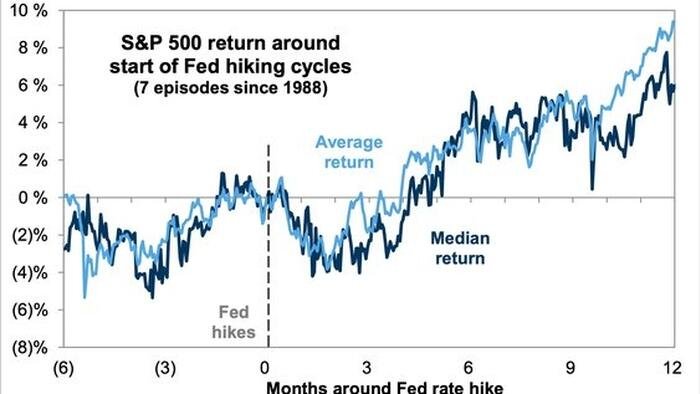
Historically, the stock market has shown resilience following initial Fed rate hikes, with modest declines typically followed by recovery and positive gains over the subsequent year. However, the current environment of a supply-driven shock poses a different challenge, potentially leading to greater market volatility and extended downturns.
Investors should consider reallocating their portfolios to sectors that benefit from inflation, such as energy and materials, while reducing exposure to long-duration assets like technology and real estate. Flexibility in response to changing market conditions is crucial, as shifts in energy prices and economic indicators can significantly impact investment performance.
Navigating Market Volatility Post-Fed Rate Hike
As investors brace for prolonged higher interest rates and potential economic slowdowns, it’s essential to assess the impact on bond markets and equity sectors. The predictive models based on past rate hikes may not fully capture the current supply-driven inflationary pressures and geopolitical uncertainties.
While the bond market presents opportunities for investors seeking yield, caution is warranted due to ongoing debt issuance and inflationary risks. Balancing exposure between long-duration bonds and intermediate maturities can mitigate risk while capitalizing on potential returns.
Ultimately, investors should remain vigilant and adaptable in their investment strategies, considering the evolving economic landscape shaped by geopolitical events and monetary policy decisions. By staying informed and responsive, investors can navigate market uncertainties and position their portfolios for long-term success.