
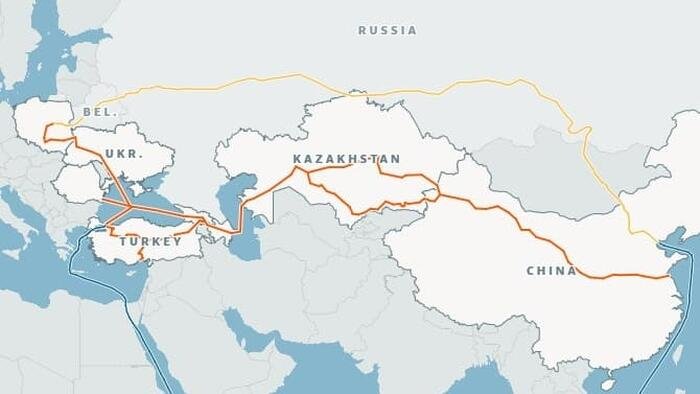
The Middle Corridor, also known as the Trans-Caspian Transport Route, is gaining traction as a key alternative for Eurasian trade. Instead of relying on vulnerable maritime chokepoints like the Strait of Hormuz, global trade is shifting towards overland routes like the Middle Corridor due to rising geopolitical instability. A $3.3 billion World Bank-backed investment push aims to address infrastructure gaps and unlock the corridor’s long-term potential. However, the route still faces major capacity and coordination constraints before it can rival established northern trade flows.
Dosym Satpayev, director of the Risk Assessment Group in Almaty, believes that the Middle Corridor offers stability in regions surrounded by geopolitical chaos, making it a desirable platform for transport and logistics projects. Major geopolitical players like China, the European Union, and the United States are showing interest in the Middle Corridor due to its strategic location and potential for economic growth. However, analysts caution that the Middle Corridor is not yet capable of fully replacing existing trade routes, especially the northern land route via Russia. It will require sustained investment, coordination between multiple countries, and years of development before it can operate at the scale of established northern routes.
For Kazakhstan, the World Bank-backed investment in the Middle Corridor signifies the country’s growing role as a central transit hub in the evolving Eurasian logistics landscape. Effective management of the process could lead to tangible benefits for ordinary people in the region, as infrastructure improvements have the potential to revive economically depressed regions. The development of hotels, gas stations, services, and maintenance infrastructure in certain regions can have a transformative effect, giving them a new lease on life. However, this potential outcome is contingent on the quality of governance and implementation.
There is optimism that with proper oversight from investors and international organizations providing financial support, these projects could also enhance the well-being of the local population.
The Middle Corridor, also known as the Trans-Caspian International Transport Route, was established in 2014 by Kazakhstan, Azerbaijan, and Georgia. This corridor aims to connect China and Europe through Central Asia, the Caspian Sea, and the South Caucasus, with further connections through Turkey. Initially overshadowed by the Russian-led northern route, the Middle Corridor has gained momentum in recent years.
Support for the corridor comes from a variety of sources, including multilateral lenders such as the World Bank, EBRD, and ADB, as well as funding initiatives from the EU and significant investments from Kazakhstan, Azerbaijan, Georgia, and Turkey. China’s involvement through its Belt and Road initiative is a key driver of trade along this route.