
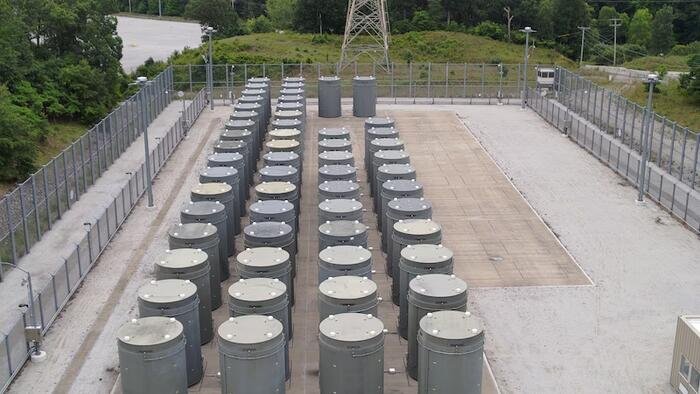
Nuclear waste is often misunderstood in modern energy production in the United States. Despite critics portraying it as a dangerous problem, the country has safely managed it for decades with an excellent safety record.
Commercial reactor spent fuel is securely stored at over 70 sites across 35 states. Transportation casks have undergone rigorous testing, including being dropped from helicopters and struck by a rocket-propelled locomotive, without any releases.
France reprocesses most of its used fuel, showcasing viable technology at a commercial scale. In the United States, there have been no significant radiation releases from commercial nuclear waste storage or handling in over 50 years.
Visual Capitalist previously illustrated nuclear waste globally, revealing that the most hazardous waste accounts for less than a quarter of one percent of the total.
A recent article from Utility Dive discusses the Department of Energy’s proposal for “Nuclear Lifecycle Innovation Campuses” to manage the nation’s approximately 95,000 metric tons of spent fuel, which increases by about 2,000 tons annually.
The campuses aim to combine waste management with regional economic benefits, generating long-term jobs and revenue for host states. Several states, including Utah, South Carolina, Tennessee, Washington, Idaho, and Nebraska, have already shown interest.
The current costs for waste management and cleanup are borne by U.S. taxpayers. The DOE’s Environmental Management program operates with a budget exceeding $8 billion annually, with the federal government’s liability for permanent disposal surpassing $56 billion.
Private companies are now competing for access to spent nuclear fuel, viewing it as a valuable resource rather than just a liability. The DOE recently awarded over $19 million to firms advancing recycling, transmutation, and isotope-harvesting technologies.
As startups see nuclear waste as a feedstock for new reactor fuel, medical isotopes, and industrial applications, competition for this resource is expected to increase. With private-sector innovation turning spent fuel into a strategic asset, the longstanding issue of nuclear waste is evolving into an economic opportunity.