
Authored by Tejasri Gururaj via Interesting Engineering
,
Global data center power demand is projected to hit
84 GW by 2027
— a 50 percent jump from 2023 levels —
with AI workloads accounting for 27 percent of that total, according to Goldman Sachs Research.
loading=”lazy”
width=”500″
height=”281″
decoding=”async”
data-nimg=”1″
class=”NodeBody_image__QqkYz”
style=”color:transparent”
sizes=”(max-width: 768px) 100vw, 1000px”
srcset=”https://files.zhedge.com/cdn-cgi/image/width=640,quality=75,format=auto/https://assets.zerohedge.com/s3fs-public/inline-images/image_80%28452%29_1.jpg 640w, https://files.zhedge.com/cdn-cgi/image/width=750,quality=75,format=auto/https://assets.zerohedge.com/s3fs-public/inline-images/image_80%28452%29_1.jpg 750w, https://files.zhedge.com/cdn-cgi/image/width=828,quality=75,format=auto/https://assets.zerohedge.com/s3fs-public/inline-images/image_80%28452%29_1.jpg 828w, https://files.zhedge.com/cdn-cgi/image/width=1080,quality=75,format=auto/https://assets.zerohedge.com/s3fs-public/inline-images/image_80%28452%29_1.jpg 1080w, https://files.zhedge.com/cdn-cgi/image/width=1200,quality=75,format=auto/https://assets.zerohedge.com/s3fs-public/inline-images/image_80%28452%29_1.jpg 1200w, https://files.zhedge.com/cdn-cgi/image/width=1920,quality=75,format=auto/https://assets.zerohedge.com/s3fs-public/inline-images/image_80%28452%29_1.jpg 1920w”
src=”https://files.zhedge.com/cdn-cgi/image/width=1920,quality=75,format=auto/https://assets.zerohedge.com/s3fs-public/inline-images/image_80%28452%29_1.jpg”
/>
Getty Images >
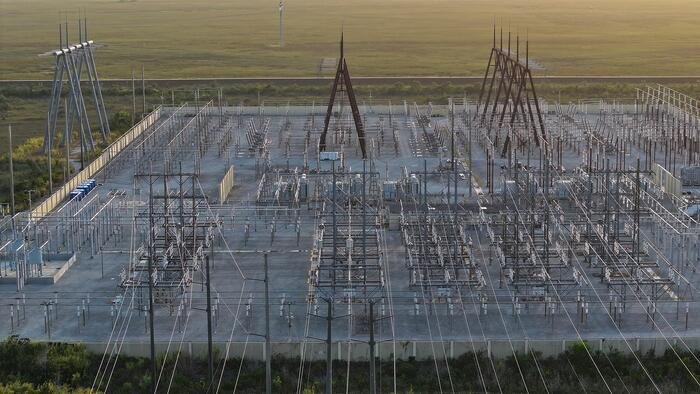
The grid cannot keep up with AI. For decades,
electricity demand
grew slowly and predictably, giving utilities comfortable margins to plan capacity years in advance. That model broke almost overnight. Between 2023 and 2024 alone, utilities’ five-year summer peak demand forecasts
jumped from 38 GW to 128 GW, a more than threefold increase in a single planning cycle.
Unlike traditional server loads, which are relatively flat and predictable,
AI inference and training jobs generate sharp, near-instantaneous power spikes. Large-scale GPU clusters can produce
fluctuations of hundreds of megawatts within seconds. That’s a load behavior utilities have no historical model for.
Energy companies are no longer treating hyperscale data centers as large customers to be served from the grid, but rather as anchor infrastructure to be co-built with.
What follows is a look at what that shift actually demands at the systems level — why natural gas is currently the only tool that can fill the gap at the required speed and scale, what that means for emissions commitments already being made today, and what the longer path to balancing this with storage, transmission, and cleaner alternatives realistically looks like.
Why natural gas is filling the gap today
The US currently generates around 40 percent of its electricity from natural gas, with coal and renewables making up most of the rest. However, neither can meet the requirements of AI data centers, which require firm, uninterrupted, gigawatt-scale power available around the clock. The
present US grid
is already under strain before data centers even enter the equation.
loading=”lazy”
width=”500″
height=”281″
decoding=”async”
data-nimg=”1″
class=”NodeBody_image__QqkYz”
style=”color:transparent”
sizes=”(max-width: 768px) 100vw, 1000px”
srcset=”https://files.zhedge.com/cdn-cgi/image/width=640,quality=75,format=auto/https://assets.zerohedge.com/s3fs-public/inline-images/img_80.jpg 640w, https://files.zhedge.com/cdn-cgi/image/width=750,quality=75,format=auto/https://assets.zerohedge.com/s3fs-public/inline-images/img_80.jpg 750w, https://files.zhedge.com/cdn-cgi/image/width=828,quality=75,format=auto/https://assets.zerohedge.com/s3fs-public/inline-images/img_80.jpg 828w, https://files.zhedge.com/cdn-cgi/image/width=1080,quality=75,format=auto/https://assets.zerohedge.com/s3fs-public/inline-images/img_80.jpg 1080w, https://files.zhedge.com/cdn-cgi/image/width=1200,quality=75,format=auto/https://assets.zerohedge.com/s3fs-public/inline-images/img_80.jpg 1200w, https://files.zhedge.com/cdn-cgi/image/width=1920,quality=75,format=auto/https://assets.zerohedge.com/s3fs-public/inline-images/img_80.jpg 1920w”
src=”https://files.zhedge.com/cdn-cgi/image/width=1920,quality=75,format=auto/https://assets.zerohedge.com/s3fs-public/inline-images/img_80.jpg”
/>
United States Department of Energy/Wikimedia Commons.

In PJM, the grid operator covering much of the Mid-Atlantic and Midwest, capacity market clearing prices for the 2026-27 delivery year saw a significant increase to $329/MW, which is more than ten times the $28.92/MW price from two years prior.
The long game: Emission costs
The gas plants currently under construction are not just a temporary solution; they represent a long-term commitment. With an average operational lifespan of 30 years, these plants will still be operational well beyond the major net-zero targets set by regulatory bodies.
A natural gas plant emits approximately 490g of CO2 per kilowatt-hour over its lifetime. When this emission rate is scaled across the gigawatts of new capacity being approved today, the environmental impact becomes a critical concern.
In the southern US, utilities are planning to add around 20 GW of new gas capacity over the next 15 years, with data centers driving 65 to 85% of the projected load growth in states like Virginia, South Carolina, and Georgia. The issue of methane emissions exacerbates the environmental impact.
The continuous leakage of methane from natural gas infrastructure, including drilling, pipelines, and compression, is a significant concern. Methane is a potent greenhouse gas that traps approximately 80 times more heat than CO2 over a 20-year period, making it a crucial factor to consider in the context of large-scale gas infrastructure development.
The policies and incentives being implemented aim to eventually shift the balance towards more sustainable energy solutions. However, these mechanisms are not progressing fast enough to address the immediate environmental challenges posed by the current energy landscape.
On the storage front, the Inflation Reduction Act of 2022 offers a 30% tax credit for standalone energy storage systems and zero-emission generation facilities placed in service after 2024. This incentive encourages investments in battery systems needed to support the continuous operation of renewable energy sources.
Nuclear power is emerging as a leading zero-carbon option for AI data centers due to its ability to provide reliable, always-on power. Companies like Google are exploring partnerships to utilize nuclear facilities for carbon-free energy supply.
The challenges related to transmission infrastructure remain significant, with gaps identified across various regions in the US. Addressing these gaps will require coordinated investment and permitting reforms to ensure a reliable energy supply for the growing AI demands.
The path forward
The increasing power demands driven by AI technologies are outpacing the infrastructure required to meet them. While efforts are being made to address these challenges through investments and policy coordination, the urgency of the situation calls for accelerated action to prevent potential power shortages and other disruptions in the future. Engineers and policymakers are working towards a sustainable solution, but time is of the essence to avoid more drastic consequences. following sentence:
The cat slept peacefully on the windowsill.
On the windowsill, the cat slept peacefully.