
Authored by Monica O’Shea via The Epoch Times,
Australian leaders have committed to enhance defense cooperation during important discussions.
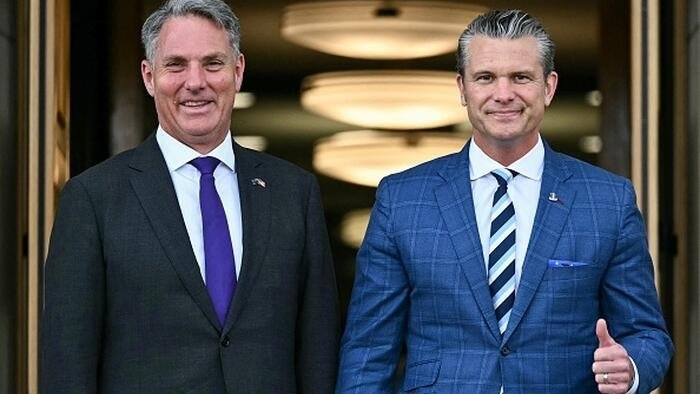
Australia’s Defense Minister Richard Marles met with U.S. Secretary of Defense Pete Hegseth at the Pentagon and Vice President JD Vance on Sept. 2.
According to a Pentagon summary of the Hegseth meeting, “both leaders agreed to expedite force posture initiatives at Australian bases, enhance cooperation in joint logistics, and increase interoperability through joint exercises. “They also talked about advancements in defense industrial cooperation to facilitate shared capabilities for guided weapons and next-generation technologies.”
Hegseth and Marles also discussed fortifying deterrence in the Pacific and developments on AUKUS.
“The Secretary and Deputy Prime Minister also highlighted progress in the AUKUS partnership and welcomed the recent deployment of U.S. Navy sailors in Western Australia to support the start of Submarine Rotational Force-West activities in 2027,” the Pentagon summary mentioned.
AUKUS is a three-way security agreement signed by Australia, the United States, and UK in 2021. The primary aspect of the deal aims to equip Australia with nuclear-powered submarines, with a total cost of up to A$368 billion.
Furthermore, Hegseth emphasized the importance of allies contributing adequately to defense efforts, while also commemorating the 75th anniversary of the ANZUS Treaty.
Marles described the discussions as “extremely productive” in statements to the press. This was his first visit to the United States since announcing Australia’s latest National Defense Strategy in April.
US, UK Submarine Force On Track For Permanent Presence
Marles from Australia also mentioned that U.S personnel were already stationed at HMAS Stirling in Western Australia, preparing the base for the Submarine Rotational Force-West – a continual U.S. and UK submarine presence.
Marles confirmed that the rotation is proceeding “as scheduled and on course” for the end of next year.
In response to queries about whether the U.S. would still deliver submarines given its construction limitations, Marles highlighted the mutual benefits of AUKUS.
“AUKUS is providing more operational days for the Virginia-class fleet of the U.S. Navy, and more operational days than a single submarine,” he explained.
Calls For Strait Of Hormuz To Be Open
Marles also mentioned that he discussed the Iran conflict with Vance and Hegseth, but did not delve into specifics of the conversation.
“Iran’s efforts to restrict shipping movement through the Strait of Hormuz are entirely inconsistent with the U.N. Convention on the Law of the Sea. It’s completely unacceptable,” he stated.
Australia also stands with the U.S. in aiming to prevent Iran from acquiring nuclear weapons.
“We’ve consistently emphasized the importance of reducing Iran’s nuclear ambitions, which is a crucial step to take, and has been central to our stance on the Iran conflict from the start …” Marles added.
The conflict between the United States and Iran began on Feb. 28 following surprise attacks on military installations and leadership.
For several months, the Iranian government has resisted while disrupting global trade by blockading the Strait of Hormuz.
On Sept. 2, U.S. President Trump asserted that the crucial waterway was under U.S. control and proposed renaming it the “Trump Strait.”
In discussions about critical minerals, Marles mentioned that meetings with Vance and Hegseth also covered the U.S.-Australian critical minerals agreement signed nearly a year ago.
According to Marles, this agreement has already unlocked $4 billion in investments for secure supply chains.