
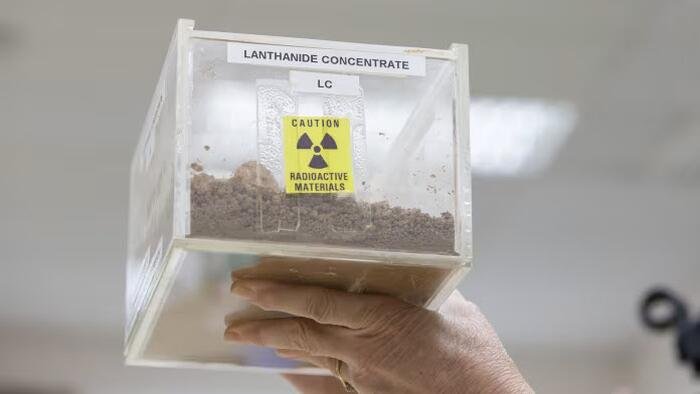
With less than three weeks until the Trump-Xi summit in China, the race for leverage and dominance is intensifying, particularly concerning the Iran war and the crucial rare earth supply chain. This is evident in the Pentagon’s efforts to secure access to rare earth elements, leading them to a small port city in Malaysia.
According to a report by the WSJ, Australia’s Lynas Rare Earths has successfully started producing heavy rare earths, a type that China traditionally dominates.
“No one had produced separated heavy rare earths outside of China in 20 years,” stated Amanda Lacaze, Lynas’s CEO. The company’s COO, Pol Le Roux, added that it had actually been 30 years.
During last year’s trade tensions, when China halted exports of heavy rare-earth elements, car factories in the US and Europe were forced to halt production. Now, Lynas is leading the charge, along with the US and its allies, to prevent Beijing from exploiting its monopoly on rare earths.
To reduce China’s control over rare earth supplies, the Pentagon has been investing significantly. In March 2026, Lynas announced a preliminary $96 million deal for the Pentagon to purchase their rare earths.
Other companies are also vying for Pentagon funding, such as MP Materials, which is planning to establish its own heavy rare earth refinery later this year. Additionally, USA Rare Earth recently announced a $2.8 billion acquisition of Brazil’s Serra Verde Group, which owns the Pela Ema rare earth mine and processing plant in Brazil.
Last month, Lynas began production of samarium oxide, a rare earth in high demand for military applications, such as heat-resistant magnets for jets and missiles.
Gracelin Baskaran from the Center for Strategic and International Studies noted that the US was spurred into bold industrial policy by events in 2025.
Rare-earth minerals are abundant in terms of mining, but the refining process, often toxic, is where the challenge lies. China, with its lack of environmental regulations, has become a dominant producer. Lynas, based in Western Australia, has been a key player outside of China.

For over a decade, Lynas has had a refinery in Kuantan, Malaysia, focusing on light rare earth production. However, last year, they completed a new heavy rare earth processor in response to the US-China trade war.
Efforts to cut China out of the supply chain involve intensive refining processes to produce pure rare earth oxides that can be supplied to customers. Heavy rare earth elements are crucial for high-temperature applications in cars and planes.
Heavy rare earths are packaged in small, valuable containers, unlike less valuable rare earths like cerium, which are bulkier. These elements are vital for high-performance magnets used in various industries.
Lynas and MP Materials are leading Western rare earth producers, with the US government pushing for more suppliers. Loans have been extended to companies like Serra Verde in Brazil to boost rare earth production.
However, there have been challenges, such as Lynas facing uncertainties in building a processing facility in Texas. Instead, they are expanding their heavy rare-earth processing facility in Kuantan, slated for completion in 2028.
Last month, Lynas achieved commercial production of samarium, a mineral previously refined mainly in China, highlighting the urgency to diversify supply chains.

As the deadline approaches for American defense companies to source rare earths outside of China, efforts are underway to ensure a stable supply chain. However, more action is needed to stimulate demand for non-Chinese rare earth magnets in commercial industries.
While progress is being made towards rare-earth independence, it is a long-term endeavor that requires sustained commitment and investment.