
Close Menu
  • Home
  • Economic News
  • Stock Market
  • Real Estate
  • Crypto
  • Investment
  • Personal Finance
  • Retirement
  • Banking

Subscribe to Updates

Get the latest creative news from FooBar about art, design and business.

What's Hot

Hyatt’s Devaluation Isn’t the Disaster It Looked Like

May 31, 2026

Walrus launches MemWal SDK to give AI agents verifiable, portable memory

May 31, 2026

Ethereum holds 50% of RWA value, yet ETH price struggles: Here’s why

May 31, 2026
Facebook X (Twitter) Instagram
  • Contact Us
  • Privacy Policy
  • Terms Of Service
Monday, June 22
Doorpickers
Facebook X (Twitter) Instagram
  • Home
  • Economic News
  • Stock Market
  • Real Estate
  • Crypto
  • Investment
  • Personal Finance
  • Retirement
  • Banking
Doorpickers
Home»Economic News»Half Of OECD Countries Earn Less Now Than Pre-Pandemic
Economic News

Half Of OECD Countries Earn Less Now Than Pre-Pandemic

August 10, 2024No Comments2 Mins Read
Facebook Twitter Pinterest LinkedIn Tumblr Email
Share
Facebook Twitter LinkedIn Pinterest Email

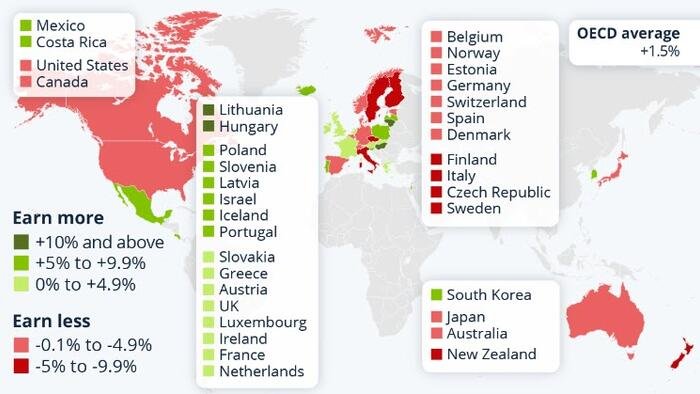
A recent report reveals that approximately half of OECD countries are currently experiencing lower earnings compared to pre-pandemic levels.

According to Statista’s Katharine Buchholz, when examining hourly real wages – wages adjusted for inflation – individuals in the United States, Canada, Japan, Australia, and various European nations are facing decreased purchasing power compared to about four years ago. Notably, no data was provided for Turkey, Chile, and Colombia.

While the pandemic led to challenges for certain sectors, some industries raised wages to attract workers amidst the disruptions caused by Covid-19. Following Russia’s invasion of Ukraine in early 2022, many workers globally experienced a decline in real wages due to rampant inflation in numerous countries, resulting in price hikes that offset any potential wage growth.

For more infographics, visit Statista

According to the OECD Employment Outlook 2024, Finland, Italy, the Czech Republic, Sweden, and New Zealand experienced the greatest impact, with real wages decreasing by over 5%. Sweden saw the most significant decline at 7.5%. The country is recognized for its comparatively low real wages despite a high cost of living—wages are 11% lower than in neighboring Denmark and 16-20% lower than in Germany, the Netherlands, or Norway. Trade unions play a significant role in negotiating contracts in the country, which emphasizes equality; however, collective bargaining has become more contentious, mirroring trends in other European nations. Observers have even dubbed this period a “lost decade” for Swedish wages.

The United States saw a lesser impact as real wages were only 0.8% lower in Q1 of 2024 compared to Q4 of 2019. In contrast, Canada experienced a 2.4% decline in hourly real wages during a similar timeframe, while Australia faced a more substantial decrease of 4.8%. The University of Sydney notes that shifts away from collective bargaining and a decline in manufacturing have influenced sectors that historically drove wage growth in the country.

Loading…

Countries earn OECD PrePandemic
Share. Facebook Twitter Pinterest LinkedIn Tumblr Email

Related Posts

“It’s All So Tiresome”: UK’s Social Media Ban Trudges Ever Onward

May 31, 2026

Bondi Claims DOJ Produced ‘Everything Required’ In Epstein Files Release

May 30, 2026

UK’s Ofcom Investigates Airing Of Trump Interview Calling Climate Change A “Hoax”

May 30, 2026
Add A Comment
Leave A Reply Cancel Reply

Top Posts

10 Most Expensive Cities in Virginia to Buy a House

January 30, 20255 Views

Best volatility ETFs: Use these funds to profit when the market falls

April 27, 20253 Views

Donald Trump delays imposing 50% tariffs on EU until July 9

May 25, 20257 Views
Stay In Touch
  • Facebook
  • YouTube
  • TikTok
  • WhatsApp
  • Twitter
  • Instagram
Latest
Personal Finance

Hyatt’s Devaluation Isn’t the Disaster It Looked Like

May 31, 20260
Crypto

Walrus launches MemWal SDK to give AI agents verifiable, portable memory

May 31, 20260
Crypto

Ethereum holds 50% of RWA value, yet ETH price struggles: Here’s why

May 31, 20260
Facebook X (Twitter) Instagram Pinterest
  • Contact Us
  • Privacy Policy
  • Terms Of Service
© 2026 doorpickers.com - All rights reserved

Type above and press Enter to search. Press Esc to cancel.