
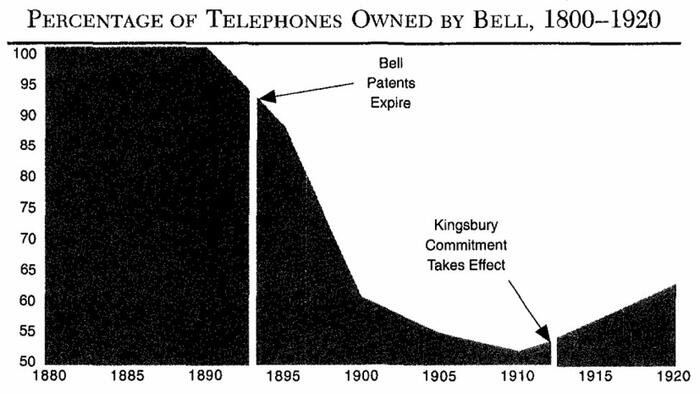
The article, originally intended to explore the reestablishment of a telephone monopoly after a brief period of free market competition, delves into the leadership strategy of Theodore M. Vail, the president of AT&T/the Bell System. Vail openly advocated for limiting competition, inviting regulation, and finding a “middle ground” between state-owned monopoly and free market competition.
Vail’s approach epitomizes political entrepreneurship and cronyism in the telephone industry. He focused on eliminating competitors, cultivating relationships with policymakers and regulators, and expanding telephone service to the public. Vail believed that effective competition and regulation were incompatible and favored the latter, leading to the consolidation of the Bell System through state intervention.
Quotes from Vail’s own words highlight his desire for government intervention and regulation to benefit AT&T. He envisioned a universal telephone system without pure market competition or full state ownership, advocating for regulated capitalism. Vail’s preference for a monopoly under one system was achieved through political means rather than full nationalization. Ultimately, AT&T’s monopoly was solidified through cronyism and state intervention, fulfilling Vail’s vision. In 1910, Vail argued that regulated companies should be shielded from competition. He stated that if there is state control and regulation, there should also be state protection for corporations that serve the whole community, even if some services are unprofitable. Vail believed that governmental control should protect investors and the public, ensuring good service and fair rates, while preventing unfair competition.
He emphasized that not all competition should be suppressed, but rather regulated and controlled. Vail advocated against unnecessary duplication, profit-sharing without assuming unprofitable burdens, and speculative consolidation or purchase objectives.
Vail believed that regulated capitalism could offer the benefits of both a free market and state ownership without the drawbacks of either. He argued that through wise state control and regulation, all the advantages of state ownership could be obtained without the burdens of public debt or operating deficits.
To avoid antitrust lawsuits, Vail orchestrated the Kingsbury Commitment in 1913, which allowed AT&T to retain its dominant position in the telephone industry while limiting its expansion through acquisitions. This agreement was seen as a more favorable alternative to dismantling the Bell System.
Overall, Vail’s strategies reflected cronyism and political entrepreneurship within the telephone industry, highlighting the complex relationship between government regulation and corporate interests.
When discussing banking specifically, Rothbard offers a profound insight that every student of economic and political history should keep in mind. He explains how cartelists were able to establish a monopoly under the guise of opposing monopoly, using rhetoric to maintain the appearance of a competitive political economy while actually reversing the content.
This history supports Gabriel Kolko’s key insight in The Triumph of Conservatism, challenging the popular narrative of the Progressive Era. Kolko argues that certain businesses actively sought and influenced regulations to create cartels or monopolies at the expense of consumers. Rather than the government and consumers working together against big business, the government often sided with these key businesses against the public interest. Competition was deemed unacceptable by many influential business and financial entities, leading them to seek government intervention to secure monopolies.
Theodore M. Vail echoed this sentiment in 1917, stating that competition in public utilities was costly and ineffective. He believed that combining similar utilities under proper regulation would result in better, more efficient, and economical service for the public compared to separate competitive systems.
sentence to make it more concise:
“Please send me the report as soon as possible.”
“Please send the report ASAP.”