

Submitted by QTR’s Fringe Finance
Friday’s selloff was not a surprise.
Between deteriorating credit markets, rising Treasury yields, increasingly absurd artificial intelligence valuations, enormous amounts of leverage and an entire financial system that has spent the better part of two decades mainlining cheap money like a frat guy guzzling Jaegermeister at the bottom of an ice luge, the warning signs have been flashing for quite some time.

The only real surprise, at least to me, is that it’s taken this long for equity investors to begin paying attention. And what worries me most isn’t how far stocks could fall, but how spectacularly unprepared investors are to deal with a market that actually goes down and stays down.
I want to start with something I read on CNBC this morning, because I think it perfectly encapsulates the extraordinary complacency and all-around ignorance that exists on Wall Street. Discussing whether increased debt issuance could become a systemic problem, Michael Rosen, chief investment officer at Angeles, offered the following assessment:
“The question is: Is this a systemic issue? Obviously, increased debt issuance is something to observe and continue to watch and be concerned about if it continues to get to levels of excessiveness. But we’re not remotely close to that right now.”
I’m sorry. What? We’re not remotely close to excessive debt issuance?
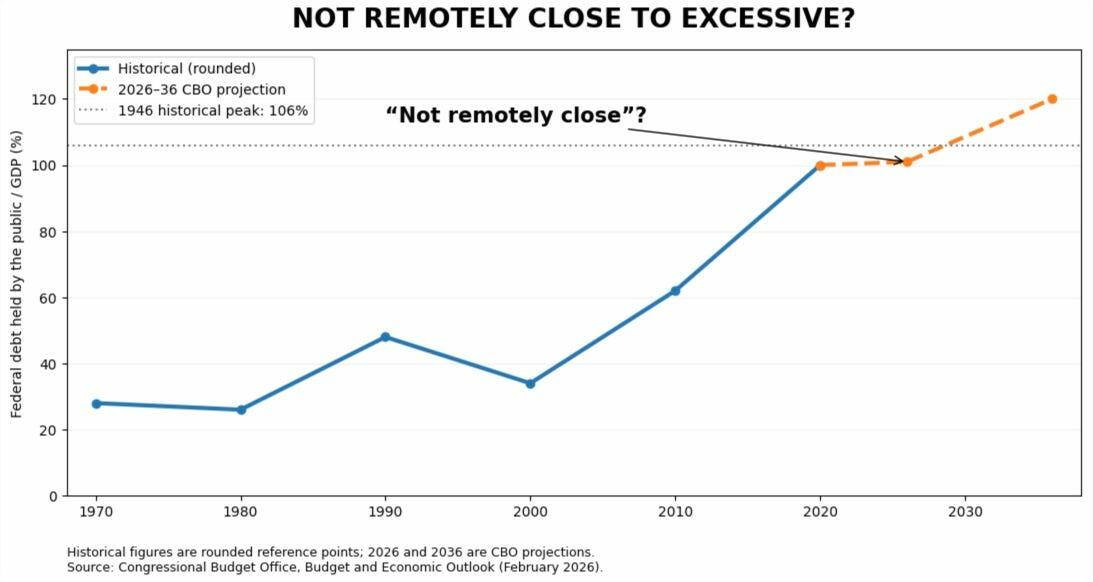
The United States has more than $40 trillion in federal debt. Annual deficits are measured in trillions. Interest expense is approaching levels that would have been unthinkable a generation ago. Corporations are borrowing enormous amounts of money to finance everything from acquisitions and share repurchases to an artificial intelligence infrastructure boom whose eventual returns remain largely theoretical.
And that’s before we get to the trillions in private credit, leveraged loans, off-balance-sheet financing arrangements, GPU-backed borrowing and assorted financial engineering Wall Street has stuffed into every available corner of the economy.
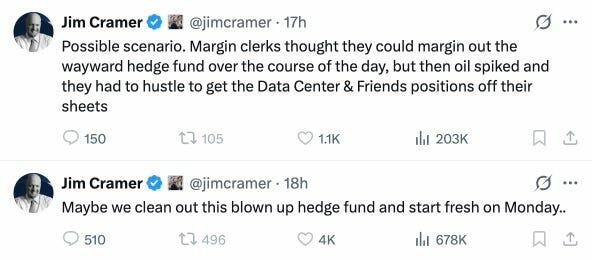
But don’t worry, everybody. Apparently we’re not remotely close to excessiveness. Oh and don’t worry about the market going down…Jim Cramer blamed Friday’s sell-off on a “big hedge fund blowing up”.
It’s hilarious to constantly be called a conspiracy theorist and then see the financial world’s predominant retail voice blaming a 2% move lower on “possible scenarios” about unnamed rogue margin clerks and hedge funds, before hoping to “start fresh” on Monday, as though $2 trillion in off balance sheet AI debt, dogshit private credit marks, positive real rates on the largest debt bubble in history and all the natural laws of mathematics are just going to go away if he closes his eyes and wishes hard enough for it.
If this isn’t excessive, what the f*ck qualifies? Does the Treasury have to start issuing debt denominated in scientific notation? Do we need to start borrowing money to pay the interest on the money we borrowed to pay the interest on the money we borrowed?
Oh, wait.
The remarkable part isn’t the statement itself. Wall Street is a cesspool of delusion and ignorance like that. It’s that I suspect a significant percentage of Wall Street genuinely believes it. We’ve spent so long normalizing financial absurdity that the concept of excess has lost its meaning. And I think that complacency is going to make the next genuine market drawdown considerably more psychologically devastating than people realize.
As part of my award-winning “The World Is Ending, So Please Prioritize Renewing Your Paid Subscription To A Former Bartender’s Finance Substack” Series, on September 23, I published Bonds Are About To Crash The Stock Market, arguing that rising Treasury yields were threatening to expose the extraordinary amount of leverage and speculative valuation built into financial markets. As I wrote then:
“Rising rates are a slow, methodical wood chipper for anything built on cheap money.”
And we’ve spent the better part of twenty years building almost everything on cheap money.
My argument wasn’t complicated. When the risk-free rate rises, everything built on cheap financing becomes more difficult to justify. Equity valuations compress, refinancing costs increase, leveraged borrowers come under pressure and speculative investments requiring endless access to capital suddenly discover that capital has a price. The equity market can ignore that math for a while, invent new narratives and convince itself that artificial intelligence has somehow repealed the laws of finance. But it cannot ignore arithmetic indefinitely.
As I also wrote in that piece, the market has spent the last fifteen years assuming we would eventually return to the financial environment that followed the Global Financial Crisis: zero rates, endless liquidity, cheap leverage and central banks standing behind asset prices. Then I asked a question I think is becoming increasingly relevant:
“What if we don’t? What if this is the reckoning?”
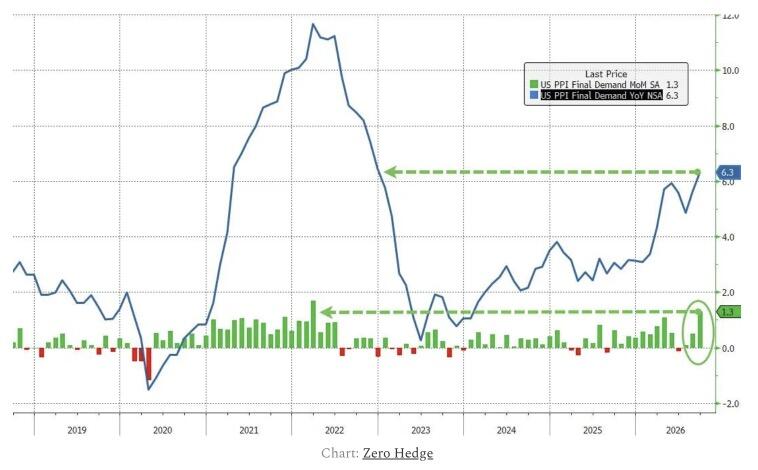
There are legitimate reasons the market could find some relief in the near term. Lower oil prices, for example, could ease inflation expectations, reduce pressure on consumers and potentially give the bond market some breathing room after scorching producer prices rose the most in 4 years this past week:
And investors will keep looking to telegraph the Fed’s next move…as long as reading the tea leaves results in confirmation bias that rates are definitely going lower very soon.
Stocks found slight intraday relief for a few moments when, speaking in Bangkok during meetings of the International Monetary Fund, Fed Chairman Kevin Warsh declined to endorse or reject recent indications from colleagues that the central bank was in no hurry to raise interest rates. Warsh said he wouldn’t prejudge upcoming meetings, adding that the Fed was entering a new chapter in which it would no longer preview its decisions.
In other words, Warsh essentially told everybody that he wasn’t going to tell them anything. And the market managed to find some relief in that.
Which tells you something about the extraordinary degree to which investors have become conditioned to hang on every syllable uttered by central bankers. We’re now at the point where the chairman of the Federal Reserve declining to speculate about future policy decisions can be interpreted as comforting news.
🔥 85% OFF FOREVER IF YOU SUBSCRIBE TODAY: I am again offering an 85% discount to anyone that wants to become a Fringe Finance annual subscriber today. It’s a discount you can keep and stays applied for as long as you wish to remain a subscriber: Get 85% off forever
For much of the recent turmoil, stocks and bonds have both been under pressure, consistent with fears about inflation, fiscal deterioration and higher interest rates. But Friday offered some evidence that the traditional flight from equities into Treasuries may finally be beginning to emerge. Longer-duration Treasuries rallied meaningfully, and the 30-year yield reportedly recorded its largest weekly decline since April 2025. That doesn’t establish a sustained rotation yet, but I think it’s something worth watching closely.
As equity losses accumulate, credit markets deteriorate and investors begin worrying less about inflation and more about preserving capital, I suspect demand for Treasuries could return in force. Yields could decline substantially even as equities continue falling. (Read: You Have To Like Bonds Here…Right?)
There is a world where falling yields are bullish for stocks because they reflect improving inflation expectations and a healthier economic outlook. And there is another world where falling yields are a symptom of investors becoming terrified of everything else. I think the second scenario deserves far more attention than it’s getting.
I suspect investors are going to be