
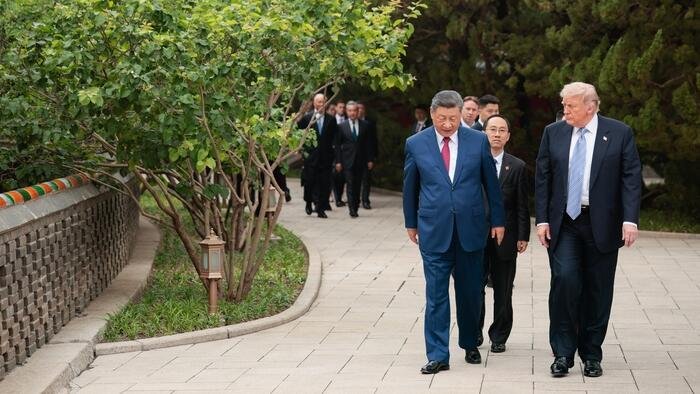
President Donald Trump and Chinese leader Xi Jinping are set to meet at the White House on Sept. 24, with a wide range of topics on the agenda. While trade, semiconductors, rare earths, Taiwan, and other disputes will be discussed, the focus will also be on artificial intelligence (AI).
AI is a transformative technology that has the potential to impact military power, manufacturing, cyberwarfare, scientific research, and the global economy simultaneously. This makes the upcoming Trump-Xi meeting more than just a diplomatic summit – it’s essentially an AI summit.
The United States and China are both at the forefront of AI development, with Stanford’s 2026 AI Index showing that the two countries have been trading the lead in AI models. While the U.S. has advantages in producing top-tier models and attracting private AI investment, China leads in AI publications, citations, patents, and industrial robot installations.
China’s manufacturing scale gives it a strategic advantage in AI, as it can deploy AI-powered machines across various industries. This, coupled with the country’s focus on open-source AI models and robotics, creates a feedback loop that accelerates AI development.
Xi Jinping is likely to seek greater access to advanced technology and push for international AI governance standards that recognize China’s role. President Trump, on the other hand, aims to keep the U.S. ahead in AI while preventing the technology from becoming an uncontrolled strategic weapon.
The central dilemma lies in whether either country can establish meaningful limits on AI development before autonomous systems become uncontrollable. The winner of the AI race stands to gain advantages across various sectors, making it a high-stakes competition.
As AI capabilities evolve, the focus shifts from who controls AI to whether humans can maintain control over the technology they created. This existential question is one that Trump and Xi cannot afford to overlook in their discussions.
In conclusion, the Trump-Xi summit is not just about diplomatic relations; it’s about shaping the future of AI and its implications for global power dynamics. The decisions made at this summit could have far-reaching consequences for the future of technology and humanity.